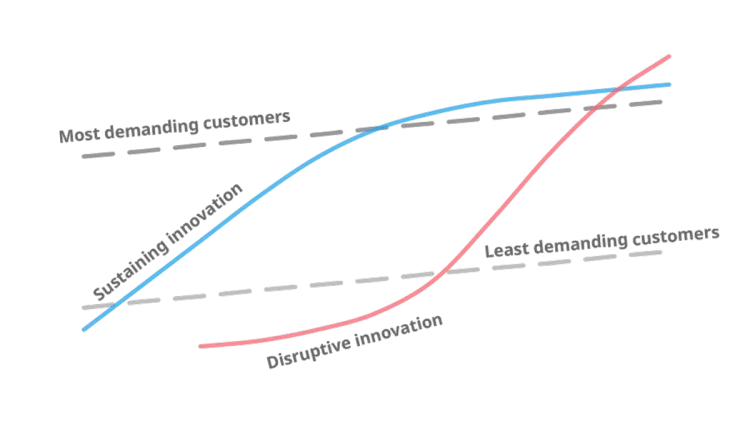
The majority of businesses need help with innovation. Only 6% of executives are truly happy with their performance in terms of innovation, according to McKinsey. Due to this, it is challenging how few corporate leaders have the confidence or expertise to address the issue before it is too late. Generally speaking, disruptive, incremental, bincremental, and radical innovations differ significantly from what businesses are used to doing most of the time. 1. Disruptive Innovation Since no system, method, or industry is immune to disruption, many find it beneficial to seek new disruptive discoveries. Reusing resources like technology can help generate new ideas that appeal to consumers. To illustrate, consider the rise of the iPhone from Apple Inc., which popularized touch displays over conventional button phones. Disruptive innovations, like everyday commercial ventures, are unmanageable because they are riskier than incremental improvements. Standardization is used to improve quality and create new goods and Continue reading
Business Innovation
The Relationship between Sustainability and Innovation

Advancement in technology and the changing lifestyles of people requires flexibility and adaptation for business to survive. Technology has affected the way business is conducted around the globe. Opportunities present are friendly to innovative people who are able to come up with different strategies to solve problems that face human beings. Innovation and sustainability have become pertinent in business’ success. Concept of Sustainability Sustainability is a term used in reference to the need to conserve natural environments. It therefore implies that all things that are important to people’s lives depend on the environment. People thrive and survive because of their environment, which allows them to gain access to water and other important resources that are pertinent to their general life ad health. Therefore, ensuring that these environments are conserved should be their obligation. Businesses and individuals need to take the initiative of ensuring that the surrounding environment is protected from bad Continue reading
Case Study of Apple Inc: How Innovation Strategy Contributes to Business Success
The Boston Consulting Group (BCG) published its ranking of the most innovative companies of 2021. The first line was taken by Apple, with Alphabet, Amazon, Microsoft, and Tesla also in the top five. The 6th position goes to Samsung; IBM Corporation takes the 7th place, and Chinese ICT giant Huawei occupies the 8th. In tenth place is Pfizer, which invented one of the vaccines for the coronavirus. Beyond that, Pfizer is one of the world’s largest drug manufacturers. Innovation is not just about making a new device; it is also about writing software code. That is done in companies that run a search engine, an operating system, or companies that make smartphones. That is why Apple has been the most technologically advanced company globally for years, and others like it are growing in that ranking year after year. In addition, Fast Company magazine ranked the innovative companies of the world Continue reading
Case Study of Ford Company: Use of Innovation for Better Competition

Ford is one of the revered car brands in the global market. The Ford Motor Company has its headquarters in Dearborn, Detroit. Henry Ford founded the automobile company in 1903. The firm has become a leading manufacturer and marketer of automobiles around the globe. The firm is known for producing the Lincoln and Ford brands. Ford competes with different companies such as General Motors (GM), Volkswagen, Toyota, and Mercedes Benz. Throughout the years, Ford has been using powerful approaches to attract more customers and improve its sales. For instance, the introduction of the Ford Mustang in 1964 revolutionized the firm’s performance. Ford also introduced and marketed new vehicles in different parts of the globe. The success of the firm led to the acquisition of Aston Martin in 1990 and Jaguar Cars in 1994. However, the beginning of the 20th century was characterized by numerous challenges such as increased fuel prices Continue reading
Case Study of Wrigley’s Orbit: Product Innovation with Market Trends for Success

Innovation can be defined as a continuous process, which is implemented in organizational practices to increase the product line and to inspire customer’s perception either in an existing or a new market. Market performance is measured through various parameters such as varying nature of market shares, profitability venture, increasing or decreasing the number of customer base and a fluctuating behavior of sales & revenues. Innovation is strongly related to market performance. It really impacts the behavior of market performance; however, the impact could be both positive and negative. When innovation brings a new product or a new service it may or may not be successful. Moreover, the market performance may produce a positive or a negative result as well. The following case study of Wrigley’s Orbit in UK market is aimed at understanding market trends that produce innovation in the market. Wrigley’s have started as a small business with just Continue reading
Open Innovation and Co-Innovation – Definition and Differences

Open Innovation and Co-Innovation Defined Innovation and innovators play a critical role in the business world. When speaking of innovators, the role of outside innovators is considered to be fundamental, and the success of companies like Apple Inc. confirms this fact. The aspect of having a reliance on outside innovators is what has given companies like Apple Inc. a name, especially when looking at the iPhone. Open innovation is the tendency of businesses to make use of knowledge inflows and outflows as the sources for ideas and acceleration of innovation strategies. Co-innovation, on the other hand, is considered to be a type of open innovation. Co-innovation is to involve the collaboration of two or more partners that work purposively in the management of the flow of mutual knowledge across the boundaries of the organizations through joint innovation and commercialization of the said innovation. Overall, open innovation allows companies to commercialize Continue reading