
Business model is a concept used in explaining various aspects of the business ranging from its value proposition to the innovation process that a particular business entity wants to adapt in its business activity. A a business model comprises two elements. These are a specific business system and a profit model. The aim of framing a business model is to conceptualize a picture on how a business operates in its operating environment. In addition to this, a business model also provides the opportunity of using the available resources best as per the ability of the firm. The aim of the firm is to maximize the utilization of the resources available to them. The two components of the business model are inclined towards describing the maximum utilization of the resources and deliver the products to the consumers in a profitable manner. The business system is concerned with the system of work Continue reading
Business Innovation
Case Study: iPod, Apple’s Best Innovation

Apple had in effect recognized an opening inside the digital music market. They had acknowledged that there was a drop in sales of digital music players due to the goods presently on the market being inadequate. Apple will have believed that the then current crop of music players were insufficient thus prompting them into designing the phenomenon that is the iPod. Due to the success of the Sony Walkman, Apple decided they wanted to enter the music player market. Therefore the company expanded from the core product of computers and software manufacture into many areas including personal music/media players (iPod). The creator of Apples iTunes was Steve Jobs, an in-house software creator. Apple released the first iPod into the market place on 23rd of October 2001. It proved hugely successful due to the software created by Steve Jobs which allows users to download music directly from the internet to the Continue reading
Importance of Innovation and Change within an Organization
In today’s constantly changing world, innovation and change play an extremely important role within any organization. New technologies like faster software and hardware and improved manufacturing systems are increasing production and changing the way we do business across the globe. Newly advancing markets are becoming more and more capitalistic, opening the door for corporations to come and do business. There are multiple elements when dealing with innovation and change within an organization. The first element is how an organization can change successfully which consists of the steps that are needed and the process that makes change happen. The next element is technological change, which is how organizations adapt and implement new technology. From new technology, organizations come up with our next element, new products and services. As these organizations become larger and larger there is the need for strategy and structure change as well as cultural changes. These two elements Continue reading
Innovation Theories: Bottom of the Pyramid and Dominant Design
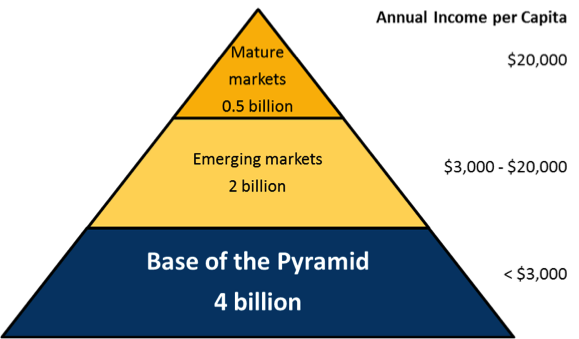
The use of innovation for sustaining businesses have been in time since the advent of businesses themselves. The ability to exploit technological developments in order to solve real problems bring about value to the people using the businesses’ products or services. The value created by a business is the result of proper innovation taking place in a multi-faceted fashion in the spheres of technology and business administration. Hence, innovation theories are a concept to extensively address and analyze real world problems to get the most valuable benefit whilst the solving the problem. Creativity lies the in heart of innovation and it is a critical ingredient that catalyzes the process of value generation via the services and products of the business. Different innovation theories have been coined and discussed globally by businesses to strategically place their products or services in a way that helps their clients or customers the most. This Continue reading
Effects of Innovative Culture on Organizations
Growth creates a need for structure and discipline, organisation changes which can strain the culture of creativity that is so vital to future success. To sustain competitive advantage, companies need to institutionalize the innovation process; they need to create an internal environment where creative thinking is central to their values, assumptions and actions. Management changes and management generally is about implementation. When the managers of an enterprise feel pressured, the fear-driven response is generally to implement better and which generally results doing more of the same only quicker or cheaper. While this is great for doing more of the same, it is still the same and meanwhile everything else is changing — customer’s needs, technology, society, macroeconomics and geopolitics are all changing. Innovation is the engine of growth. It is also a mindset — meaning it is influenced by beliefs, values, and behavior. Company culture therefore has a huge influence Continue reading
Role of Organizational Climate in Facilitating Innovation

One of the most important roles that the leaders play within organization settings is to create the climate for innovation. Organizational climate is a key factor in innovation implementation. Building up an innovative culture in an organisation is one of the important tasks of an innovative leadership. At the same time, creative organizational climate is one of fundamental elements that leads to success of innovation. Doing so successfully will certainly further secure and strengthen the leadership, which initiates innovative climate in the first place. This success will also bind more followers to the leadership because of its respective contributions for innovation, or in another word future success. A leadership should have a quality and skills to manoeuvre the internal environment of an organisation to create a favorable climate for innovation. Although there is no direct influence between organizational climate and innovation, a favorable climate can naturally drive people to seek Continue reading