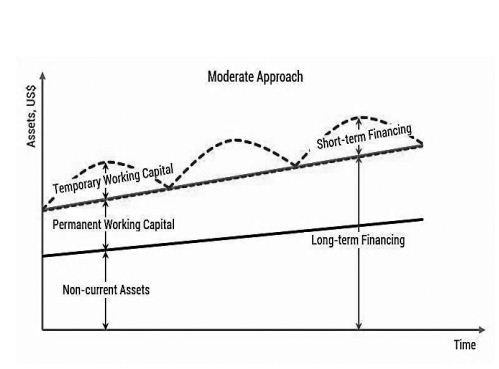
Working capital is said to be the life blood of a business. Working capital signifies funds required for day-to-day operation of the firm. In financial literature, there exist two concepts of working capital namely: gross and net. Accordingly, gross concept working capital refers to current assets viz: cash, marketable securities, inventories of raw materials, work-in-process, finished goods and receivables. According to net concept, working capital refers to the difference between current assets and current liabilities. Ordinarily, working capital can be classified into fixed or permanent and variable or fluctuating parts. The minimum level of investment in current assets regularly employed in business is called fixed or permanent working capital and the extra working capital needed to support the changing business activities is called variable or fluctuating working capital. There are broadly 3 working capital management strategies/ approaches to choose the mix of long and short-term funds for financing the net working Continue reading
Corporate Finance Concepts
Leasing – Meaning, Types, Benefits and Limitations

Leasing is understood to be a financial instrument that permits an individual or the lessee to enjoy the utility of a physical asset without possessing it or without assuming ownership of the asset. Leasing can also be defined as an arrangement between two main parties namely: the lessor or the leasing company and the person or the lessee. The customer or the lessee can rent the asset from the company for a particular period of time. The rent for leasing are always predetermined and are due after a particular fixed intervals of time and the lessee assumes the ownership of the property for the entire lease period. There is no purchase option at the expiry of the lease period. Leasing applies to equipment’s that are expensive and bulky or large. Leasing has advantage of tax exemption since the individual avoids the per annum leasing charges; also there is the advantage of avoiding Continue reading
Corporate Finance – Concept and Meaning
Business firms and government organizations do need to implement various programs to achieve their goals. Implementing programs require resources such as natural resources, human resources and financial resources. Effectiveness in the management of financial resources is key to optimize the use of natural and human resources. In the case of individual, management of financial resources or funds is known as personal finance. The same is called by public finance in government organizations. Corporate finance is used to refer to the management of funds in the context of business firm. Thus, finance as a discipline is classified into three domains: public finance, business finance and personal finance. Public finance is the management of funds for governments: both local government and central government. Traditionally, it deals with the management of revenue and expenditure of government. Personal finance refers to the management of funds of and individual. Generally, business finance, corporate finance and Continue reading
Advantages and Disadvantages of Ratio Analysis
Ratios are an expression of one number in terms of another. This form of analysis facilitates comparison between the financial performances of different businesses or industries. Ratio, vertical and horizontal analysis are commonly used by financial analysts because they are useful tools for planning, controlling and monitoring an organisational performance. A range of financial ratios are there, including: liquidity, solvency, profitability, efficiency and investor ratios. Advantages of ratio analysis include: Ratio analysis enables the users of the financial statement to make comparisons between the financial performances of two or more businesses, even if they are of different sizes or from different industries, by converting financial numbers into standardized form using pre-defined formulas. Ratios are easy to calculate and do not consume significant amount of time. Ratio analysis is a useful tool to monitor and control a business organisation’s performance. The users of the financial statements are often interested in assessing Continue reading
Factors Influencing Dividend Payouts of a Company
Dividend is a form of payment made to shareholders by an organization; It’s a profit which is paid out to the company shareholders. When a profit is earned by the company, the profits are used again to invest for a better growth of the company for its future, or it can also be paid to the company shareholders in the form of dividends. Dividends are also paid to the shareholders in the form of cash or shares. The company must have sufficient funds in order to pay dividends to its shareholders. Dividends are generally paid out by a company only when the company make good profit and it’s been paid form its earnings. Dividend policy is of great interest n today’s financial industries when the joint stock companies came into existences. Dividends can also be defined as “a distribution of company’s earnings which is decided by the board of directors Continue reading