Organizations, by definition, are entities with boundaries. External boundaries separate a company from its suppliers and customers and define its geographic reach. Internal boundaries separate the departments between each other, management from employees. Such lines of differentiation have been necessary. Different departments in the organization work towards the common goal the overall success of the business. However, companies that thrive within the new environment of global competition, rapidly changing technologies, and shifting markets are characterized by not having many boundaries. The new model of success is defined as “boundaryless organization”, a term created by Jack Welch during his term as CEO of GE. A boundaryless organization is a contemporary approach in organizational design. In a boundaryless organization, the boundaries that divide employees such as hierarchy, job function, and geography as well as those that distance companies from suppliers and customers are broken down. A boundaryless organization seeks to remove vertical, Continue reading
Management Concepts
Concept of Power in Management

Power in Management Power is easy to feel but difficult to define. It is the potential ability of a person or group to influence another person or group. It is the ability to get things done the way one wants them to be done.Both formal and informal groups and individuals may have power; it does not need an official position or the backing of an institution to have power. Influence can take many forms. One person has influenced another if the second person’s opinions, behavior or perspectives have changed as a result of their interaction. Power is a factor at all levels of most organizations. It can be a factor in almost any organizational decision. Power and Authority Sometimes power and authority is used synonymously because of their objective of influencing the behavior of others. However, there is difference between the two. Power does not have any legal sanctity while Continue reading
What is Research and Development (R&D)?
For a new business initiative it is essential to recognize the development stages through which the enterprise is likely to pass, and prepare for the issues and challenges which will be faced. For a business unit within a corporate it is important to recognize that the same development process applies — often with the same challenges! However, these challenges are sometimes eased by the protection of an established corporate parent able to soften the impact of negative cash flow and poor profitability at the relevant stages. Creativity becomes the responsibility of Research and Development (R&D), which is staffed by specialists in visualizing and realizing marginal or major product changes. Ever since companies such as Dupont and Bell Labs first took, and successfully traveled along, this road, setting up a separate R&D group has been a popular way to enhance value at the concept stage. There are many ways of distinguishing Continue reading
Relationship Between Organizational Behavior and Management Control System
Organizational Behavior and Management Control There is a close relationship between organizational behavior and management control system. A management control system seek to evaluate and regulate the performance of responsibility centers. The manager in charge of a responsible center is rewarded for good performance. At the same time when the performance of a responsibility center is dismal, the manager in charge is punished. Thus, a management control system acts as a double-edged sword. That is why manager are afraid of a control system and, may resist it. In order to make a control system successful, it is necessary to understand the factors that motivate, managers to achieve the results. Behavioral sciences have given several concepts that are relevant to management control. Some of these concepts at described below. 1. Perception. Whether a management control system is accepted and implemented successfully does not depend on the system. It depends largely on Continue reading
Organizational Architecture

By organizational architecture, we mean the entire organization, including organizational structure, control systems and incentives, processes, organizational culture and people. In this case, there are three conditions to be fulfilled by an organization to make the organization profitable. First, various elements of the organization shall be parallel to each other. Second, organizational strategy should always be consistent with the organizational structure, and finally, strategies and organizational structure must be consistent with the competitive conditions prevailing in the firm’s market that are the strategy, architecture and competitive environment. As noted above, the organizational architecture is the totality of the organization itself which consists of various components. The components are the structure, control systems and incentives, processes, organizational culture and people. The organizational structure is a formal organizational structure used to manage a firm. Control system is the system used to measure the performance of managers and units while the incentives Continue reading
Case Study of Nokia: Lessons from the Collapse of a Global Tech Leader
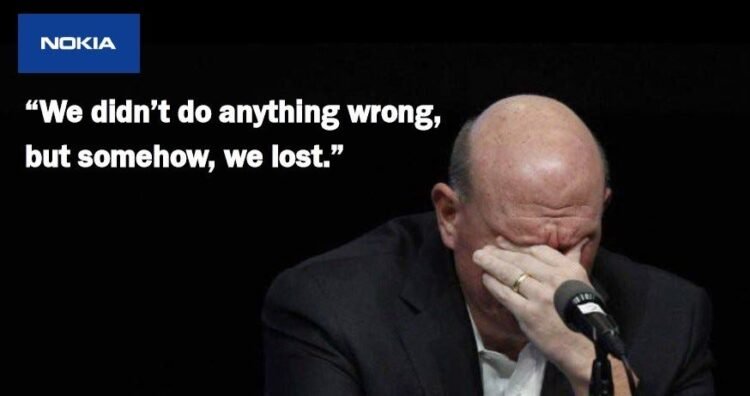
The company Nokia was established in 1865 and focused on the manufacture of paper; at the beginning of the 20th century, Nokia became a power industry company. Only at the end of the 20th century, the company’s core business became the development, production, and sales of mobile phones. The company experienced a peak in sales and popularity in the market at the end of the 1990s and in the 2000s but had to face a decline at the end of the 2000s. In 2013, the company sold its business to Microsoft. The main failure that led to the company’s decline was its inability to adapt to the demands of the market, i.e. provide products that would be efficient in the era of the mobile Internet. The company was not prepared for the emergence of new technology (smartphones) and failed to understand the consumers’ needs. The company’s investment in its operational Continue reading