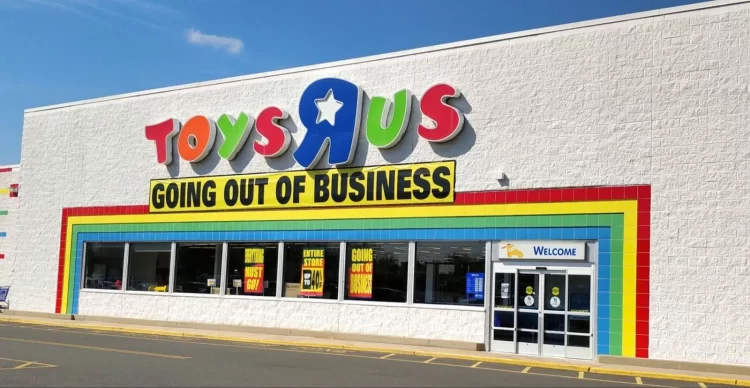
In 1948, Charles Lazarus founded Toys “R” Us as a children’s furnishing company. He used investments from savings and bank loans. In 1957, the organization founded its first formal toy shop, completely devoted to children’s toys, and became public in 1978. The firm had several conventional toy stores, shops focusing on baby commodities, over 100 children’s apparel stores, and various educational specialist stores. Nonetheless, the firm owned numerous toy shops in other international countries, led by Asian vendors. Toys “R” Us offered its items online via toysrus.com and other platforms, with online retailing performed through a partnership with Amazon. Inc. In 1982, the company expanded its product line by adding the Kids “R” Us and Babies “R” Us labels, bearing copyrights. These brands enjoyed tremendous development and became one of the most frequented sites for toys and children’s clothes. The company experienced robust achievements during its inception stages, and the Continue reading
Management Case Studies
Management case studies are real-life examples of issues and problems found in particular workplaces or business organisations. Case study assignments give the opportunity to relate theoretical concepts to practical situations. Most case studies are written in such a way that the reader takes the place of the manager whose responsibility is to make decisions to help solve the problem. In almost all case studies, a decision must be made, although that decision might be to leave the situation as it is and do nothing.
Business Strategy Case Study: Relaunch of Fiat 500

On 4th July 2007, Fiat Auto the Flagship division of Fabbrica Italiana Automobili Torino (FIAT) re-launched its heritage brand the Fiat 500. It was exactly 50yrs after the launch of Fiat 500 on 4th July 1957, which not only helped Fiat in post World War-II recovery but also provided mass motorization to Italians. Luca De Meo, CEO, Fiat Auto, on the re-launch occasion stated that “This is the car that gave ordinary Italians four wheels for the first time; that transformed a country and a company.” In its 18yrs of career between 1957 and 1975, 3,893,294 Fiat 500s were built & sold, which provided millions of Italians and Europeans individual mobility. Post 1970 with beginning of free trade in Europe, Fiat’s market share eroded continuously. Foreign companies such as Volkswagen, Renault, Ford, Peugeot, Honda and Toyota became prominent players in the Italian car market threatening survival of Fiat. The prime Continue reading
Case Study: Citibank “Live Richly” Ad Campaign

Founded in 1812 as the City Bank of New York, this urban merchant’s bank continued to expand and diversify its services over the next century. The bank changed its name to Citibank, N.A. (National Association), in 1976, following its parent holding company’s change to Citicorp. In 1998 Citicorp and the Travelers Group completed a $76 billion merger to form Citigroup, Inc. Citicorp was at the time the second-largest commercial bank, and Travelers Group was a leading international insurance/investment banking firm. The Citicorp-Travelers merger thus represented a new era of horizontal expansion. Citigroup then began an acquisition spree that included acquiring in 2002 Golden State Bancorp (the parent company of First Nationwide Mortgage and California Federal Bank), a move that added 352 branches and approximately 1.5 million new customers to Citigroup. By then the company was well on its way to having 3,000 bank branches and consumer-finance offices in the United Continue reading
Case Study: Hospital Management System (HMS)
XO Hospital Management System XO Infotech Ltd. has developed a core package — Hospital Management System that addresses all major functional areas of Hospital. The development environment ensures that XO HMS has the portability and connectivity to run on virtually all standard hardware platforms, with stringent data security and easy recovery in case of a system failure. XO HMS provides the benefits of streamlined operations, enhanced administration and control, improved response to patient care, cost control, and increased profitability. Some of the Subsystem Modules in XO HMS: Reception: The reception module handles various enquiries about the patient’s admission and discharge details, bed census, and the patient’s movements within the hospital. The system can also handle fixed-cost package deals for patients as well as Doctor Consultation and Scheduling, Doctor Consultancy Fees and Time Allocation. OPD, IPD Registration and Admission: This module helps in registering information about patients and handling both IPD Continue reading
Case Study of Zara : Application of Business Intelligence in Retail Industry

ZARA is a Spanish clothing and accessories retailer based in Arteixo, Galicia. Founded in 24 May ,1975 by Amancio Ortega and RosalÃa Mera, the brand is renowned for it’s ability to deliver new clothes to stores quickly and in small batches. Zara needs just two weeks to develop a new product and get it to stores, compared to the six-month industry average, and launches around 10,000 new designs each year. Zara was described by Louis Vuitton Fashion Director Daniel Piette as “possibly the most innovative and devastating retailer in the world. The company produces about 450 million items a year for its 1,770 stores in 86 countries. The Zara has made of use of Information Systems (IS) and to advance in many areas. This has resulted in huge success for the company. This included application of Business intelligence (BI) involves technologies, practices for collection, integration and applications to analyze and Continue reading
Case Study: McDonalds Marketing Strategies
McDonald’s is the world’s largest fast-food restaurant chain. It has more than 30,000 restaurants in over 100 countries. Over one billion more customers were served in 2007 than in 2006. Although net income was down by $1.1 billion in 2007, McDonald’s sales were up 6.8%, and revenue was a record high of $23 billion. “The unique business relationship among the company, its franchisees and suppliers (collectively referred to as the System) has been key to McDonald’s success over the years. The business model enables McDonald’s to play an integral role in the communities we serve and consistently deliver relevant restaurant experiences to customers.” McDonald’s overall strategic plan is called Plan to Win. Their focus is not so much on being the biggest fast-food restaurant chain, rather it is more focused on being the best fast-food restaurant chain. McDonald’s “strategic alignment behind this plan has created better McDonald’s experiences through the Continue reading