The rupee was historically linked i.e. pegged to the pound sterling. Earlier, during British regime and till late sixties, most of India’s trade transactions were dominated to pound sterling. Under Bretton Woods system, as a member of IMF Indian declared its par value of rupee in terms of gold. The corresponding rupee sterling rate was fixed 1 GBP = RS 18. When Bretton Woods system bore down in August 1971, the rupee was de-linked from US $ and the exchange rate was fixed at 1 US $ = Rs 7.50. Reserve bank of India, however, remained pound sterling as the currency of intervention. The US $ and rupee pegging was used to arrive at rupee-sterling parity. After Smithsonian Agreement in December 1971, the rupee was de-linked from US $ and again linked to pound sterling. This parity was maintained with a band of 2.25%. Due to poor fundamental pound got Continue reading
Managerial Economics
Managerial Economics generally refers to the integration of economic theory with business practice. It deals with the use of economic concepts and principles of business decision making. Managerial Economics is thus constituted of that part of economic knowledge or economic theories which is used as a tool of analyzing business problems for rational business decisions. Managerial economics can be viewed by most modern economists as a practical application of economics theory in using effectively the firms scarce resources.
Capital Account Convertibility and India
According to the Tarapore Committee provided a succinct and subtle definition: Capital Account Convertibility refers to the freedom to convert local financial assets into foreign financial assets and vice versa at market determined rates of exchange. It is associated with changes of ownership in foreign/domestic financial assets and liabilities and embodies the creation and liquidation of claims on, or by, the rest of the world. IMF’s Role in Capital Account Convertibility Convertibility is an IMF clause that all the member countries must adhere to in order to work towards the common goals of the organization. However CONVERTIBILITY per se can be looked into from various perspectives and incorporated accordingly by the member nations. An economy can choose to be (a) partially convertible on CURRENT ACCOUNT (b) partially convertible on CAPITAL ACCOUNT (c) fully convertible on current account and (d) fully convertible on capital account. It is important to state here Continue reading
Role of Supply Side Policies in Balanced Economic Growth
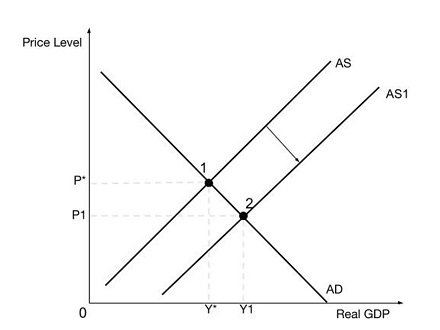
The government has a responsibility for delivering public goods optimally for the collective development of all individuals. In the quest to achieve this noble course, supply side policies, which form part of macroeconomic strategies, are developed to ensure that markets and industries function in an efficient way to increase the rate of economic growth as reflected in the real national yield. Many governments support the assertion that they can achieve a sustained economic growth by improving supply side operations without causing an increase in inflation. However, reforms on the supply side policies do not facilitate the achievement of adequate growth. Definition and Explanation of Balanced Economic Growth Although the growth rate does not reflect people’s living standards entirely, economic growth has been one of the critical areas of consideration for every nation that is in the process of developing its economic policies. Indeed, economic growth is the most common approach Continue reading
Concept of Demand in Managerial Economics

In Economics, use of the word ‘demand’ is made to show the relationship between the prices of a commodity and the amounts of the commodity which consumers want to purchase at those price. Definition of Demand: Hibdon defines, “Demand means the various quantities of goods that would be purchased per time period at different prices in a given market.” Bober defines, “By demand we mean the various quantities of given commodity or service which consumers would buy in one market in a given period of time at various prices, or at various incomes, or at various prices of related goods.” Demand for product implies: a) desires to acquire it, b) willingness to pay for it, and c) Ability to pay for it. All three must be checked to identify and establish demand. For example : A poor man’s desires to stay in a five-star hotel room and his willingness to Continue reading
Economic Tools for Management Decision Making

Managerial decision-making draws on economic concepts as well as tools and techniques of analysis provided by decision sciences. The major categories of these tools and techniques are optimization, statistical estimation and forecasting. Most of these methodologies are technical. These methods are briefly explained below to illustrate how tools of decision sciences are used in managerial decision making. 1. Optimization Optimization techniques are probably the most crucial to managerial decision making. Given that alternative courses of action are available, the manager attempts to produce the most optimal decision, consistent with stated managerial objectives. Thus, an optimization problem can be stated as maximizing an objective (called the objective function by mathematicians) subject to specified constraints. In determining the output level consistent with the maximum profit, the firm maximizes profits, constrained by cost and capacity considerations. While a manager does not resolve the optimization problem, he or she may make use of the Continue reading
Dornbusch Exchange Rate Overshooting Model
The Dornbusch overshooting model, developed by Rudiger Dornbusch in 1976, is a theoretical framework used to explain the dynamics of exchange rates. It suggests that when there is a change in monetary policy or other economic factors, exchange rates overshoot their long-run capital flows before settling back to their equilibrium levels. The model helps explain the short-term volatility of exchange rates, which can have significant implications for international trade, investment, and capital flows. Assumptions of the Model: The Dornbusch overshooting model is based on several key assumptions. First, it assumes that prices and wages are sticky in the short run, meaning that they do not adjust immediately to changes in economic conditions. This is because many contracts, such as labor contracts and long-term supply contracts, are negotiated in advance and do not reflect current market conditions. As a result, changes in the money supply or other economic factors can lead Continue reading