
In the modern world, so many organizations are using several strategies to enhance their performance and improve their competitive advantages. Some of the mostly relied on strategies are divestitures or mergers & acquisitions. The two though somehow different have some similarities. Mergers and Acquisitions refers to two companies combining together to form a single entity or one parent company absorbing another company and completely eliminating the entity of the target company to incorporate its operations in the parent company. Divestitures or rather divestment on the other hand is the opposite of investment and refers to the reduction/addition of the firm’s partial assets or complete sale of an existing business by a firm due to some ethical or business reasons. One of the reasons behind the above corporate strategies is to increase the firm’s chances of survival in a market environment characterized by many competitors and in particular perfect market industry. This is Continue reading
Strategic Management
Strategic management is the art and science of formulating, implementing and evaluating cross-functional decisions that will enable an organization to achieve its objectives. It involves the systematic identification of specifying the firm’s objectives, nurturing policies and strategies to achieve these objectives, and acquiring and making available these resources to implement the policies and strategies to achieve the firm’s objectives. Strategic management, therefore, integrates the activities of the various functional sectors of a business, such as marketing, sales, production etc. , to achieve organizational goals. It is generally the highest level of managerial activity, usually initiate by the board of directors and executed by the firm’s Chief Executive Officer (CEO) and executive team.
Relationship between Strategy Formulation and Strategic Planning
The word “strategy” or “strategic” is used in both terms, there is a possibility of confusion. The distinction is that strategy formulation is the process of deciding on new strategies, whereas strategic planning is the process of deciding how to implement the strategies. In the strategy formulation process, management arrives at the goals of the organization and creates the main strategies for achieving those goals. The strategic planning process then takes the goals and strategies as given and develops programs that will carry out the strategies and achieve the goals efficiently and effectively, The decision by an industrial goods manufacturer to diversify into consumer goods is a strategy formulation, a strategic decision, after which a number of implementation issues have to be resolved: whether to diversify through acquisition or through organic growth, what product lines to emphasize, whether to make or to buy, which marketing channels to use the document Continue reading
Process Reengineering – History, Definition and Process Steps
The driving force behind all the changes which are taking place in the all the firm of the world are two Cs: customers, competition. The demands of the customers are changing day by day and this change in demand of customers pose new sets of challenges to the firms every now and then and hence firms have to change or modify their offering to customers accordingly. Firms who are able to do it in less time and less cost turn out to be the industry leaders. Firms set their mission and vision statements on the basis of their short term and long term strategy and to attain those goals firms need to adjust themselves with the constantly changing environment. We have seen dominance of Japanese firms in automobile and electronic components, the reason for this dominance of Japanese firms over other firms round the world is their techniques. They change Continue reading
Resource Based View (RBV) and Sustainable Competitive Advantage

Resource based view (RBV) focuses on the internal factors that contribute to a firm’s growth and performance. It highlights the importance of firm’s resources and capabilities. Both of them will together form a competency that can create a competitive advantage. Resources can also be divided into tangible resources and intangible resources. Capabilities of the firm in utilizing the resources have a big impact on how a firm will be able to stand out among other competitors. Competitive advantage arises when a firm has a lower cost structure, products differentiation and niche markets. RBV also concerns in value creation in order to compete with others. On the other hand, in order to survive in this competitive world, a firm needs to fully prepare itself to achieve sustainable competitive advantage (SCA), which means having a superior performance in a longer term compared to other rivals. According to Jay Barney (1991), resources need Continue reading
Harmon’s Process-Strategy Matrix
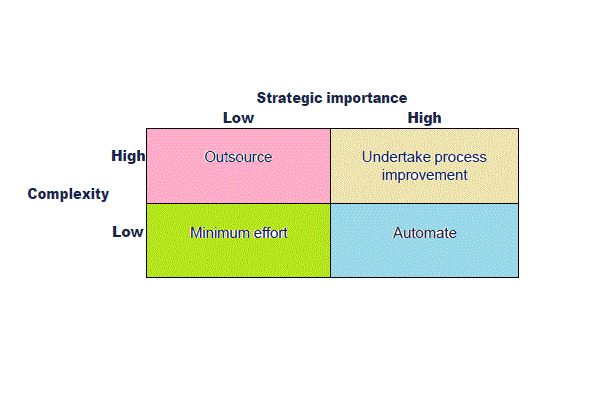
Process-Strategy matrix by Paul Harmon will be useful in deciding how the process should be managed, it gives two variable one Is importance and other is complexity and dynamics. There may be other variables to consider in practice such as culture, cost and savings and quality. It should be used flexibly by considering all the variable affecting the current and future prospects of the organization. Advantages and disadvantages should be considered before reaching the final decision. How To Assess The strategic Importance? Strategic importance can be assessed by asking what would happen if a process is abandoned. If it impacts the business objective (Quality, cost control and reputation etc.) materially (more than insignificant) than it can be assessed as high strategic importance like threatening to the survival of business. Strategic importance can also be assessed by identifying key stakeholders. If the process affecting the key stakeholders like customers, Tax authorities Continue reading
Socially Responsible Strategies
A question of central interest here is, how can corporations formulate socially responsible strategies? How can companies assure that corporate domain choice strategies and competitive strategies are responsive to social needs and do not harm the public interest? There are two basic approaches to dealing with these questions. First is to evaluate the social merits of each corporate and business strategy selected based on financial, technological, and market criteria. For each strategy, one could ask these questions: What social good does the strategy contribute? Does the strategy create any public risks or harm? Does the strategy harm the interests of our stakeholders? How does the strategy affect public image and goodwill? Will the strategy lead us into social controversies? The answers to these questions can aid in modifying strategies to fit reasonable demands. The idea is not to abandon strategies that have even the slightest negative consequences, but to consider Continue reading