In 1948, Charles Lazarus founded Toys “R” Us as a children’s furnishing company. He used investments from savings and bank loans. In 1957, the organization founded its first formal toy shop, completely devoted to children’s toys, and became public in 1978. The firm had several conventional toy stores, shops focusing on baby commodities, over 100 children’s apparel stores, and various educational specialist stores. Nonetheless, the firm owned numerous toy shops in other international countries, led by Asian vendors. Toys “R” Us offered its items online via toysrus.com and other platforms, with online retailing performed through a partnership with Amazon. Inc. In 1982, the company expanded its product line by adding the Kids “R” Us and Babies “R” Us labels, bearing copyrights. These brands enjoyed tremendous development and became one of the most frequented sites for toys and children’s clothes. The company experienced robust achievements during its inception stages, and the organization’s adoption of various success drivers attributed to this.
In particular, Lazarus’ pricing strategy radically differed from his competitors: he offered the most-desired things for minimal or no profit. Shoppers thought that the remainder of the store’s merchandise was also affordably priced and continued their shopping there. Furthermore, Toys “R” Us created a new segment to offer name-brand children’s clothing at reduced costs to compete with new market entrants. The corporation opened two prototype Kids “R” Us locations in the city of New York that were aesthetically pleasing and satisfied buyers. Concurrently, other extravagantly designed branches contained electronic games and well-named divisions. Kids “R” Us successfully replicated some of Toys “R” Us’s strategies, including bargain pricing, strict inventory control, bulk buying, and building outlets in reduced-rent strip malls along main roads. In 1983, the company’s revenues topped $1 billion, reaching $1.3 billion. Hence, becoming one of the top performing organizations at that time.
Notably, the company’s success was due to its buying power, enormous variety, large stockpiles, and ability to identify high-selling items swiftly; therefore, fiscal sales surpassed the previous year by nearly double figures. The company’s strength lies in its volume of stores that it operates, many of them in emerging economies that could prove to be an investment. It recently filed for bankruptcy in the United States and Canada. At first glance, the company is suffering from low sales, not enough foot traffic, and toys that do not appeal to children of the digital age. However, at looking closer, the underlying issue seems to be Toys “R” Us’s reluctance to re-engineer its business.
Toys “R” Us was losing sales due to big retailers like Amazon, Target, and Walmart. Amazon offers the convenience of online shopping with very fast shipping that eliminates the wait time associated with shopping online. Target and Walmart offer one stop shopping that allows an individual to get all of their shopping done without having to make multiple stops. Toys “R” Us only offers one genre of products, which are toys.
When compared to a similar rival within the same industry such as American Girl Doll, it is clear that it is possible to be successful while offering an exclusive product. The appeal of American Girl Doll is that it creates a unique, interactive experience for its customers. One of Toys R Us’ weaknesses is that is does not have a competitive edge. Toys “R” Us could do the same by providing unique, interactive, experience geared displays for children in their stores similar to that of Build-A-Bear, which is a competitor in the same market. They can also manage a turn around by focusing on lower prices, better customer experience, revamping stores to include the interactive portion, hire engaging employees who cater to children, offer other services such as toy repairs or setup assistance.
Toys “R” Us is a retail company that is exclusively a toy retailer that has 866 stores in the United States and more than 750 international locations. It had consistent success since it was founded in 1948 because it provided the most popular, up to date, and largest variety of toys with the most locations as well. Toys R Us was known as a category killer, which meant that the company sold a product from only one category. With this strategy, the company was able to build a large volume that other retail chains could not match due to Toys R Us’ inventory and price. Then, Walmart launched a price war that was matched by Target and sold more toys than Toys “R” Us by 2005. KKR, Bain, and Vornado acquired Toys R Us in 2005 for $6.6 billion. The retailer has $4.9 billion in debt of which $400 million is due in 2018 and $1.7 billion due in 2019.
Toys “R” Us has filed for bankruptcy in the United States and Canada, which will help relieve it from this debt. This can be attributed to the rise of e-commerce, where people buy online on sites such as Amazon and eBay. Toys R Us did launch its own website in 1998 and it became one of the fastest growing sites in the toy category. As Toys R Us tried to improve its business strategy, so did its competitors. Walmart and Target also sell toys but also offer the convenience of one stop shopping for its customers whereas Toys R Us is unable to do so. In the age of technology, many children prefer I-Pads and I-Phones to traditional toys further dwindling sales of Toys R Us. In 2011, Toys R Us’ domestic U.S. sales were worse than that of 2008, which was one of the worst holiday seasons for retailers. The president of the company resigned after only 10 months despite signing a one-year contract. In 2012, the department heads for administration and merchandising also resigned from their positions. The executives at Toys R Us have been experiencing high turnover within the past seven years. The company is grappling with how to grow the business with all of the competition.
In an effort to compete with potent competitors and the emerging e-toy industry in 2000, Toy “R” Us signed a 10 year contract with Amazon to give exclusive rights to sell Toys “R” Us products on its website. This was huge as it was the first deal of its kind, and cost the toy company approximately $50 million a year. Unfortunately, Amazon failed to provide the agreed upon exclusivity. In spite of the deal, Amazon created a marketplace where it continued to sell other toy brands. In 2004, Toys “R” Us sued Amazon to end the partnership due to the breach of contract. This was a significant financial setback, as well as missed opportunity to develop an e-commerce presence. During the fight to settle the lawsuit and secure a spot in the e-commerce world, big-box retailers discounted prices to reel in consumers who shopped at Toys “R” Us. As a result, Toys “R” Us’ stock dramatically decreased.
Sales are dwindling and competition is thriving but what caused these issues to arise for a company that seemed to doing very well? KKR and Bain Capital acquired Toys R Us in 2005 for $6.6 billion plus $1 billion of debt at a total valuation of $7.6 billion. KKR and Bain Capital put in $1.3 billion and used the company’s assets to raise the remaining amount bringing the debt from $1 billion to $6.2 billion, which was 82.7% of total capital. The interest rate on this debt was around 7.25% that created payments of $450 million per year on interest alone. The plan was to cut company costs, improve cash flow, and pay off the debt. The rise of e-commerce, at the time, was not anticipated. Amazon was only an $8.5 billion company in 2005 as opposed to the $100 billion dollar giant it is today. The executives set the company up for failure right from the acquisition.
Due to its debt, Toys “R” Us was unable to venture into the online market as aggressively as they should have to counter Amazon. The company also could not keep up with Walmart’s low prices. Walmart would take a loss by pricing toys and other popular items at steeply low prices to get customers into their stores so they could spend on other big-ticket items. Customer service and shopping experience at Toys R Us were sub par at best and not inviting to customers. American Girl Doll, which is also an exclusive toy retailer, has seen tremendous, continuous success due to its interactive geared shopping experience for customers. American Girl Doll only sells doll, which one would assume could be its detriment as was with Toys R Us. The same factors that plague Toys R Us are the same factors that American Girl Doll must deal with. American Girl Doll is able to thrive and be profitable because of the unique experience they provide. Each toy comes with a historical background, a story, and accessories, which sell even at their high price point. Smaller neighborhood toy stores are thriving and increasing sales every year while Toys R Us, a retail giant is failing. What sets these smaller stores apart is the customer service of helpful employees, the carefully curated selection, gift-wrapping services, and Lego building events. These stores are providing a unique shopping experience that Toys R Us is lacking. “Kids these days are restless – they’re looking for an interactive experience,” said Susan Lee, a partner at marketing firm Simon Kucher & Partners. It isn’t enough to just have stacks of toys on a shelf. Customer service plays a large part in the success of these smaller stores as well. A variety of different experiences shoppers reiterated at a store called Child’s Play from employees going out of their way to open newly packaged games so children can decide if it is the right one, tracking down obscure toys that some children request, and even taking the time out to play with some of the kids in the store.
Simultaneously, the toy industry continuously changed. Kids were no longer into traditional toys and, with the help of technology, were more interested in electronics such as computers, video games, and tablets. In 2017, Toys “R” Us enlisted the help of restructuring advisors to address the $400 million debt deadline that was quickly approaching. In an effort to reorganize, the company tried to upgrade the in-store experience by creating Nerf target practice areas, and allowing consumers to fly drones in hopes that customer traffic and sales will increase. The toy retailer also price-matched online holiday deals from Amazon and other e-commerce retailers to compete with competitors. These efforts simply were not enough, and were a little too late.
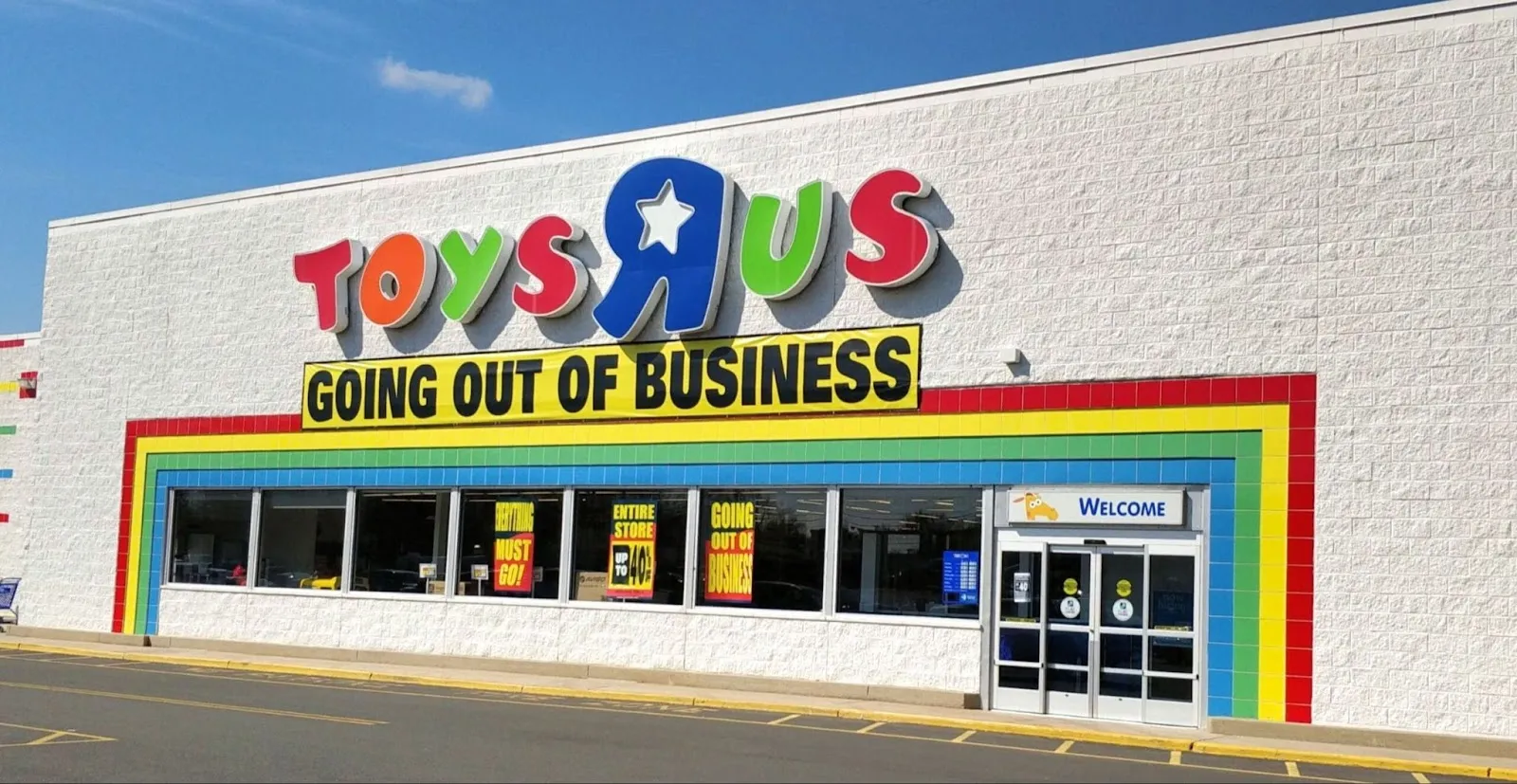
The toy store seriously considered filing bankruptcy, a move that isn’t normally alarming in the retail industry. However, when toymakers became aware, they were deeply concerned and would not risk giving Toys “R” Us products it could not pay for. Within one week of the article’s publication, nearly 40 percent of its vendors refused to ship product without cash on delivery. Within three weeks, Toys R Us was forced to file bankruptcy without a plan to emerge and before the crucial holiday season. Manufacturers limited their shipment to Toys “R” Us, crippling the retailer in the midst of the holiday season. As a result, big-box retailers cut their prices, baiting in toy shoppers who chose discounts over the convenience of shopping at Toys “R” Us. During the 2017 holiday season, Toys “R” Us’ earnings were $250 million below budget projections, further paralyzing the company. The company predicted it would run out of cash in the U.S. by May 2018.
Causes of the Toys “R” Us Failure Are Listed Below;
Seasonal Sales – Toys “R” Us targeted significant holidays like Christmas to get a big market for their products. During such periods, most people would buy the products as gifts, thus raising the sales ratio. This dependency made it difficult for the firm to achieve the expected financial outcome as revenue income varied from time to time, depending on the period of the season. It, therefore, resulted in poor operating results as profit targets were not mostly met.
Lack of Competitive Advantage – Retail companies like Walmart, Costco, and Amazon have strategized their market operations by giving a range of offers to their clients, for example, home deliveries, lower prices for commodities, and other enticing packages. This method has lured customers to shop with retailers leaving Toys “R” Us stranded with limited consumers for their goods. Without unique offers, the firm could not beat competitors in the market for toys.
Competitors – The toy industry has a good number of retailers providing similar products. The competition level increased and thus became a fundamental threat to the Toys “R” Us brand. The large number of suppliers made consumers have several stores or different shops to buy the dolls at a much better price making the company experience a decline in sales of its commodities. On the other hand, online competitors played a significant role in increasing the number of toy games, thus adding stress to the toy market.
The Constant Change of Consumer’s Behavior – The trend of customers’ tastes and preferences kept changing that required the firm to keep track of the alterations to meet the clients’ needs. Toys “R” Us could not evolve quickly to sustain the rapid development needs of the people. This made it lag in satisfying the needs of the loyal consumers, making them opt for other providers of the toy products like Amazon and Target.
Going Bankrupt – The Toys “R” Us industry incurred losses in its operation that prompted the management board to seek and sign protection from such dismal performance. The firm was operating under a debt of about $5 billion. Such great losses created low trust and confidence amongst the vendors. Moreover, the managers did not anticipate and initiate an early move to secure the growing platform of eCommerce in the current business system. The late call in the movement gave added advantage to its competitors who grows stronger hence keeping it below into the market of online retailers.