A brand is defined as a name, term, sign symbol (or a combination of these) that identifies the maker or seller of the product. In order for a brand to succeed in the ever increasing market, brand building activities such as promotion and advertisement must be conducted in order to gain awareness to establish and promote the company.
Financially, Brand Equity is described as the total value of a brand which is a separable asset – when it is sold or included in a balance sheet. Kotler (2013) defines Brand Equity as the “differential effect that knowing the brand name has on customer response to the product or its marketing.” Aaker (1991) defines Brand Equity as, “a set of brand assets and liabilities linked to a brand, its name and symbol, that add to or subtract from the value provided by a product or service to a firm and/or that firm’s customers.” The brand assets are grouped into five categories; Brand Loyalty, Name Awareness, Perceived Quality, Brand Associations and other proprietary Brand Assets – patents, trademarks, channel relationships. It can be argued that Brand Equity offers guidance to interpret past marketing performance and design future marketing programs.
Brand Equity can be used to guide brand building activities when a company wants to expand their product line. If a consumer has a positive attitude towards the brand they are more likely to remain loyal and purchase from them again. This highlights that the concept of Brand Equity is useful when the brand is already established. Brands with high brand equity enjoy high purchase intention, purchase loyalty and consumer preference and so therefore should be considered when expanding a product line. An example of a Brand that has strong Brand Equity is Apple thanks to its loyal consumer base and targeted advertising. It is ranked among number one in the best global brands in 2024 and is worth 3.21 trillion.
However, it can be argued that Brand Equity is actually formed once a brand has been created and therefore is a product of brand building activities. The customer based definition stresses that the power of a brand lies in what resides in the hearts and minds of customers. Therefore, it could be argued that it is not actually used to guide brand building activities but is better defined as the pinnacle point of building a strong brand.
The Brand Resonance Model, more commonly known as Keller’s Brand Equity Model or the Consumer-Based Brand Equity (CBBE) Model illustrates the four steps of six building blocks (Salience, Imagery, Performance, Judgements, Feelings, Resonance) that businesses should take in order to develop a successful, strong brand. It has been highlighted that once the brand has reached the top of the pyramid, they will have a completely harmonious relationship between customers and their brand and will gain the advantage of increased loyalty and a reduction of competition in the market. Subsequently, it could be argued that the model provides a yardstick by which brands can assess their progress in their brand-building efforts as well as a guide for marketing research initiatives which mirrors that of Brand Equity.
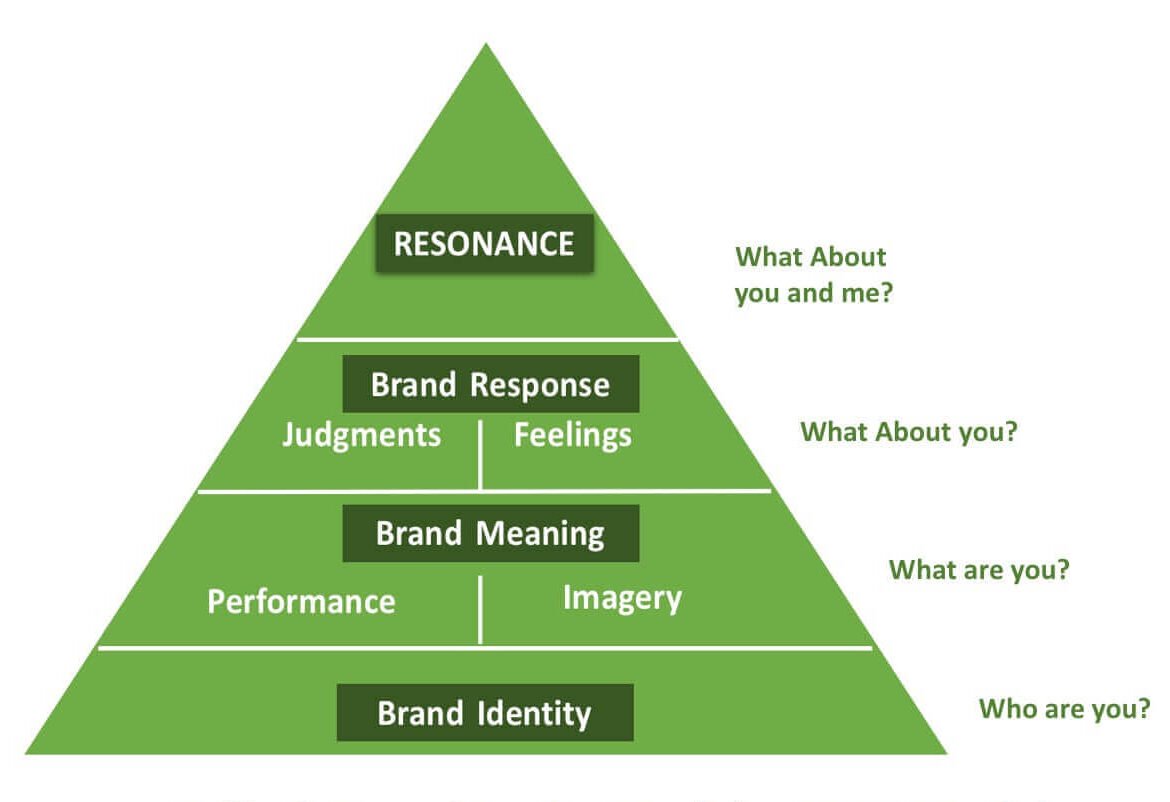
Brand Salience; the first section of the pyramid is defined as the tendency of the product or brand to be noticed or thought of in buying situations. In order for a brand to stand out in an ever – increasingly crowded and cluttered brand race, the brand must be salient. Strong brands such as Apple have high brand salience and therefore have a greater chance of recall compared to competing brands such as Nokia. A positive way in which brands can become more salient is by using Celebrity endorsements. It has been stated that celebrity endorsement leads to a favorable attitude toward the endorsed brand and influences advertising effectiveness, brand recognition, brand recall, purchase intentions and even purchase behavior with brand attitudes and purchase intentions are affected positively by celebrities. An example of a successful celebrity endorsement campaign is Chevrolets #BestDayEver. Their aim was to change people’s views towards them as a brand and to get rid of the apathetic views. Chevrolet achieved this by partnering with celebrities across social media and radio personalities that weren’t directly tied to Chevrolet. Using celebrities that were ‘new’ to them enabled the company to reach new audiences and afforded them the opportunity to target millennials through their use of social media platforms as well as an 8-hour live stream on YouTube. The campaign consisted of, ‘Acts of Awesomeness’ happening all over the US, ranging from Chevrolet paying for a woman’s fuel to Kelly Clarkson hosting a lunch for new mums. The campaign saw preconceived ideas eradicated with 1.5 billion social media impressions and a 35% increase in Brand opinion. As a result of celebrity endorsements, Chevrolet were able to target a wider range of potential consumers which in turn enabled them to alter misconceptions of them as a brand, whilst increasing brand awareness by capturing their attention therefore making them more salient. However, it must be noted that before a brand is salient, market segmentation should be undertaken in order to ensure that the brand is targeting the right consumers. Celebrity endorsement is only effective if the right people are being targeted, thereby highlighting that this model has its limitations. If market research and market segmentation were undertaken before Brand Saliency, the model might arguably be more effective.
Brand meaning; the second section of the pyramid is made up of two categories of associations that exist in customer’s minds which are related to performance and imagery. The associations can be formed directly (from a customer’s experience and contact with the brand) or indirectly (through the portrayal of the brand in advertising or by word of mouth.) At this stage points of parity and points of difference should be highlighted to customers. An example of a company that portrays a strong brand meaning is Patagonia, a clothing company making high quality outdoor clothing and equipment which has successfully demonstrated both brand performance and imagery. Its brand performance highlights reliability and durability mirroring their core values as a company that design clothes for simplicity and utility. It’s brand imagery is heightened by its commitment to donating time, services and at least 1% of all sales to help grassroot organizations. Customers feel immersed in the charitable aspect of their purchase which enables them to feel partly responsible for helping the environment. As a result, Patagonia are able to further their Brand Equity financially through a morally aesthetic route, thereby building upon the foundations of a secure brand. However, due to the fact market segmentation might not have been conducted earlier in the model, this stage could be deemed useless if not targeted at the right consumers. Whilst Patagonia have a strong brand image, if it doesn’t relate to their target market, consumers are more likely to buy from competitor’s brands such as, North Face.
The third stage of the Brand Resonance Model is Brand Responses which refers to how customers respond to the brand and states what customers think or feel about the brand. This building block is split into two sections; Judgements and Feelings. Judgements include overall quality, credibility, superiority and consideration whilst feelings include the customer’s emotional responses and reactions to a brand. In order to build a strong brand, both judgements and feelings must be considered. A brand building activity which could make a brand stronger is advertisement due to the emotional responses and reactions it can generate. It is without doubt that Herbal Essence’s revitalizing and Fruit Fusions Shampoo advert has engendered brand feelings with consumers as the advertisement depicts a woman using the product and exclaiming ‘Yes, yes, yes’ generating four of the six important types of feelings (fun, excitement, social approval and self-respect.)
Brand Resonance is the final stage of the model and arguably the most desirable to reach. It refers to the nature of the relationship that customers have with the brand. It can be broken down into 4 stages; loyalty, attachment, sense of community and active engagement. Brand resonance is the key to building deep attachments and evoking strong emotions. Harley Davidson is a brand that has established a strong brand by using this principle. Its customers are extremely loyal with around 45% of owners having previously owned a Harley. There is a sense of community due to the fact they have a global Harley Owners group which organizes regular events for its 900,000 members, who enjoy benefits of magazines, a touring handbook, emergency road service, insurance and discount hotel rates. The company has been able to create a community of enthusiasts ranging from young children to the elderly.
Keller’s Brand Equity Model or Brand Resonance Model is effective in helping guide brand building activities as it creates a checklist for brands to complete in order to gain more Brand Equity. It must be noted that Keller’s model does have its limitations however. The model is focused on Business to Consumer and certain sections do not fit the Business to Business relationship. For example, the model is focused on the individual brand but Business to Business products are often marketing under a manufacturer label where the companies name is used. It can be argued that the Brand Resonance model reflects a customer focus rather than a business focus.
In conclusion, the Keller’s Brand Equity Model or Brand Resonance Model guide brand building activities by marketers. However, it is without doubt that the concept of Brand Equity alone would not be sufficient to guide a brand but used in conjunction with the brand resonance model it would be more effective. Whilst they both aid in building a brand they do both have limitations. Brand Equity; whilst it is imperative in brand building it is hard to measure. Similarly, the Brand Resonance Model misses out specific brand building activities which if aren’t correctly carried out could alter the way the brand is built.