Kübler-Ross’ Five Stage Change Curve Model, also known as the Kübler-Ross Change Model or the Change Curve, is a framework that outlines the emotional stages individuals typically go through when facing significant change. The Change Curve is based on a model originally developed in the 1960s by Dr. Elisabeth Kubler-Ross to explain the grieving process. Since then it has been widely utilized as a method of helping people understand their reactions to significant change or upheaval. Kubler-Ross proposed that a terminally ill patient would progress through five stages of grief when informed of their illness. She further proposed that this model could be applied to any dramatic life changing situation and, by the 1980s, the Change Curve was a firm fixture in change management circles. The curve, and its associated emotions, can be used to predict how performance is likely to be affected by the announcement and subsequent implementation of a significant change.
The five stages of the Kübler-Ross Change Curve Model are as follows:
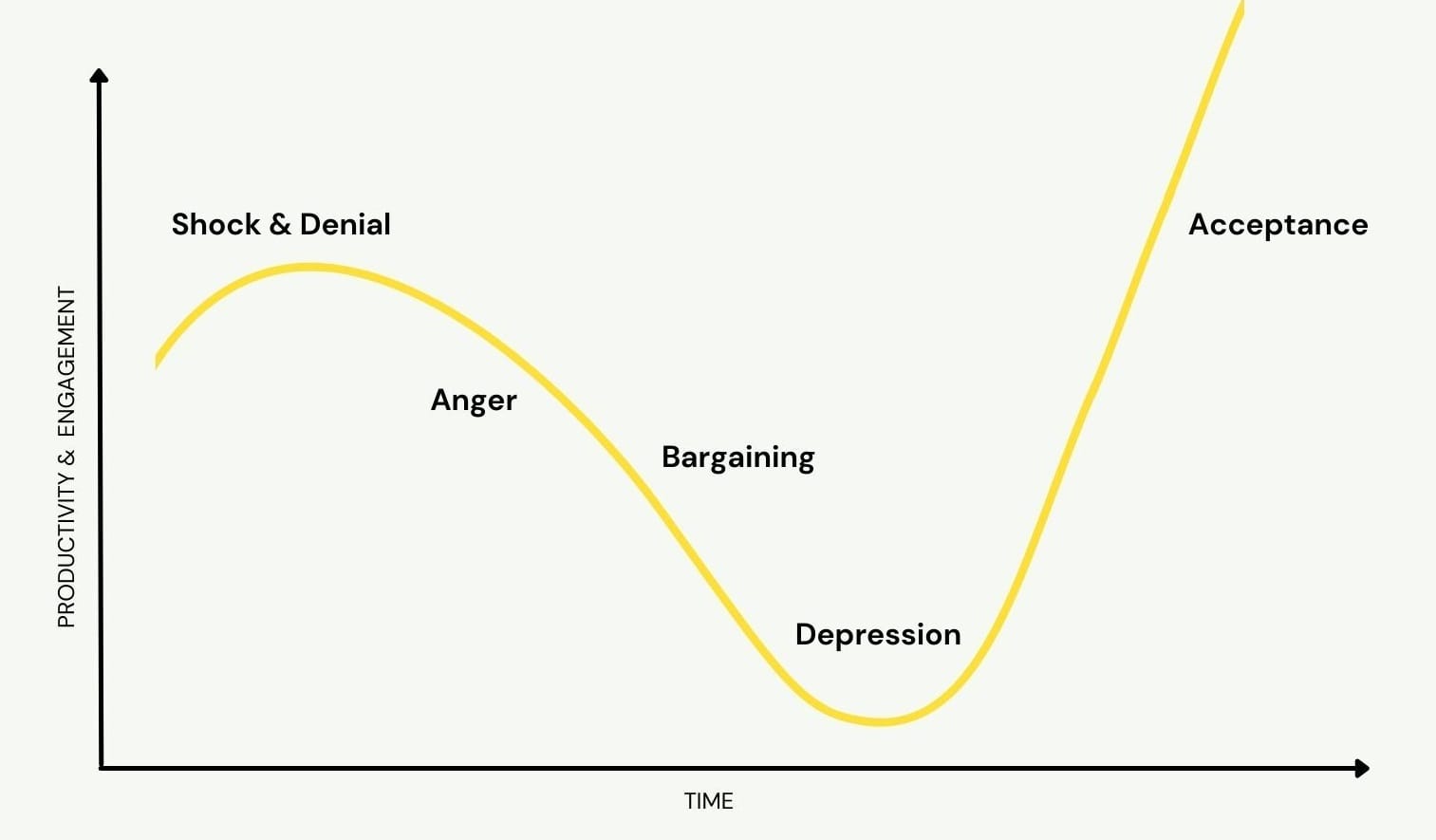
- Denial – The first stage of the Kübler-Ross Five Stage Change Curve Model is denial. In this stage, individuals may struggle to accept or acknowledge the reality of the change. They may experience a sense of disbelief or shock, refusing to believe that the change is happening or that it will have a significant impact on their lives. Denial acts as a defense mechanism, allowing individuals to cope with the initial overwhelming emotions that arise from the change. They may cling to their familiar routines, beliefs, or comfort zones as a way to maintain a sense of stability and control. Denial can manifest as avoidance, minimizing the significance of the change, or even engaging in wishful thinking that things will go back to the way they were. However, as individuals begin to confront the facts and evidence of the change, they gradually move towards the next stage.
- Anger – As denial gives way, individuals may enter the stage of anger. This stage is characterized by intense emotions of frustration, resentment, and even rage. Individuals may direct their anger towards the change itself, feeling a sense of powerlessness or injustice. They may also direct their anger towards those perceived as responsible for the change, such as leaders, decision-makers, or colleagues. Additionally, individuals may experience anger towards themselves, feeling guilty or blaming themselves for not preventing the change or for their perceived inability to adapt. Anger serves as a natural response to the disruption and upheaval caused by the change. It can be a manifestation of the individual’s resistance to letting go of the familiar and accepting the new reality. During this stage, it is crucial to provide space for individuals to express their anger constructively and to help them process their emotions effectively.
- Bargaining – The third stage of the Kübler-Ross model is bargaining. In this stage, individuals may attempt to negotiate or bargain as a way to regain what has been lost or to mitigate the impact of the change. They may engage in a series of “what if” scenarios, seeking alternative solutions or ways to revert to the previous state. This stage often involves making promises or seeking compromises in the hope of avoiding or minimizing the consequences of the change. Individuals may engage in discussions, propose alternative plans, or try to find ways to influence the outcome. Bargaining is rooted in a desire to regain a sense of control or to preserve what is familiar and comfortable. However, as individuals realize the limitations of bargaining and the inevitability of the change, they begin to move towards the next stage.
- Depression – The fourth stage of the Kübler-Ross model is depression. In this stage, individuals experience a profound sense of sadness, loss, and hopelessness. They may feel overwhelmed by the magnitude of the change and the challenges it presents. This stage involves a deep emotional response characterized by withdrawal, disengagement, and a loss of interest in previous activities or relationships. Individuals may experience a sense of grief for what has been lost and may struggle with feelings of emptiness or despair. It is crucial to note that depression in this context is different from clinical depression and should be understood as a normal emotional response to change. During this stage, individuals may benefit from support, empathy, and opportunities to express their feelings and process their emotions in a safe and understanding environment.
- Acceptance – The final stage of the Kübler-Ross model is acceptance. In this stage, individuals come to terms with the change and embrace the new reality. Acceptance does not necessarily mean complete happiness or satisfaction with the change, but rather a recognition and willingness to adapt and move forward. Individuals in this stage develop a more realistic perspective on the change and begin to explore possibilities and opportunities within the new context. They may exhibit a renewed sense of energy, openness to change, and a willingness to learn and grow. Acceptance allows individuals to shift their focus from what was lost to what can be gained from the change. It empowers them to make the necessary adjustments, develop new strategies, and find ways to thrive in the new environment.
What are the Learning for the Organizations?
This is very reliable tool to understand/help the different stages of employee who are going through significant transformation in organization. It also helps department head to understand the transition of his team mates to one position to other or one department to other department. And this further helps manager to build a good road map or different strategy to support employee transition to finally make controlled situation and successful task completion.
Trying to explain with some real example “Change of role”.
Stage 1 – Denial: He doesn’t accept the sudden change. He start thinking why it’s happened to him only.
- Overcome with situation: – Give clear communication why there is change of role. What is purpose behind it and why its require? It may be need of organization with his specific skills.
Stage 2 – Anger: So employee understand the denial can’t continue and he realized the situation but there is anger and frustration.
- Overcome with situation: – when people leave their comfort zone then they need time to adopt the situation and this adapt situation make sometime people frustrating. Other than communication, they also need support to adopt with current situation and spare some time. This is natural reaction as changes are not really smooth always.
Stage 3 – Bargaining: Employee start negotiation to reach on the point of compromise. They may try to find best place to fit themselves.
- Overcome with situation: – Understand/assess the current level of employees and feed them with good training skills which make them more productivity instead of working in compromise way.
Stage 4 – Depression: Adjustment with situation or adjusting in different team with different skill people is not always easy which make employee feel sad and depressed.
- Overcome with situation: – More astonishing training, finding easier way to explain situation, try making situation ease for employee so that he can adjust, make social gathering within office with team members.
Stage 5 – Acceptance: Employee finally accepting the changes. Some start working with new change and some may resign due to unfit the situation.
- Overcome with situation: – Productivity improved as employee either with you working as per new changes.
Advantages of Kübler-Ross Change Curve
- This model gives insights to understand the emotional stages involved in any process of change. If these are managed better, then entire journey of change will be smooth and successful. It allows for the development of strategies and interventions to support individuals through each stage, minimizing resistance and facilitating a more successful change implementation.
- This model useful because it is very easy to understand and apply to any situation. People can relate it to their personal and professional lives and be able to understand the transitional stages. By identifying the stages of denial, anger, bargaining, depression, and acceptance, the model highlights the importance of providing emotional support during times of change. It encourages individuals and leaders to create a supportive environment where emotions can be acknowledged and addressed.
- The model promotes open communication and engagement throughout the change process. Recognizing that individuals may go through different stages at different times, it encourages dialogue, active listening, and collaboration, facilitating smoother transitions and greater acceptance of change.
Limitations of Kübler-Ross Change Curve
- This model lacks empirical evidence to support its assumptions and it fails to fully explain complex forms of emotions people have to cope with during change process. The model’s categorization of emotions into five stages may oversimplify the complexity of individual experiences during change. Emotions and reactions can vary greatly among individuals, and the model’s rigid structure may not capture the full range of emotional responses.
- These stages of grief or loss are neither sequential nor work in parallel. It is not always that a person must reach the last stage, as he may get stuck in any stage.
- The model is also criticized for being relevant to some situation and some culture and it is not applicable to all situations of entire change process.
- The model primarily focuses on the negative emotions and challenges associated with change, such as denial, anger, and depression. While it acknowledges the stage of acceptance, it may not sufficiently emphasize the potential for growth, learning, and positive outcomes that can arise from change.