Aligning Business Ethics and Corporate Social Responsibility

History tells us that ethics generate trust. But before anything else, ethics create a reputation, which in turn develops the elements of trust between people. The thrust of intensive ethical attention in business is brought about by the growing power of consumers towards businesses. Gone are the days when they would just buy products based on what it offers because now they would likely care about the brand’s practices. Consider the impact of Nike’s marred reputation on its economic activities when unethical workplace environments and practices were made public. The company was quick to decide on what it should do to the situation, which is to gain public trust again through public showmanship of ethical efforts. Although ethical choices are unavoidable and ethics is inescapable even in business, the intensity of such phenomenon has increased due to the growing concern on the collective impact of a business’ unethical action. The Continue reading

Importance of Strategic Planning

Strategic planning encourages, managers to take a holistic view of both the business and its environment. The importance of strategic planning is its ability to harness a series of objectives, strategies, policies and actions than can work together. Managing a company strategically means thinking and accordingly taking suitable action on multiple fronts. Due to involvement of multiple operations objectives, strategies, policies or actions may, on the surface, appear contradictory and mutually exclusive, but in reality they can work together. Strategic planning provides the framework for all the major business decisions of an enterprise-decisions on business, products and markets, manufacturing facilities, investments and organizational structure. In a successful corporation, strategic planning works as the path finder to various business opportunities, simultaneously it also serves as a corporate defense mechanism helping the firm avoid costly mistakes in product market choices or investments. Strategic planning has the ultimate burden of providing a corporation Continue reading

Extrinsic and Intrinsic Rewards – Impact on Individual and Organization Performance

In this competitive environment nowadays, organisations are predicted to be more aggressive on empowering the employees because the employees’ job satisfactions are important for the whole organizational performance. Because of this reason, in order to achieve the organization’s missions and goals, the effectiveness on managing the motivation of employees should not be excluded. The motivation such as employees’ satisfaction on their works or the rewards given to them leads to better performance in their organization. Rewards are the performance incentives that given by the company to the individuals due to their good work performance. There are two types of rewards that normally implemented by the organizations to motivate the employees, extrinsic rewards and intrinsic rewards. Based on the Vroom’s expectancy theory of motivation, extrinsic rewards are positively valued work outcomes that the individual receives from some other person in the work setting, include such things as pay, financial incentives, security, Continue reading

Demand Curve under Different Market Structures

Firm Demand (company demand) denotes the demand for the product/s of a particular firm. While Industry demand means the demand for the product of a particular industry. An industry comprises all the firms or companies producing similar products which are quite close substitutes to each other irrespective of the differences in their brand names. To understand the relation between company and industry demand necessitates an understanding of different market structures. The demand curve of an individual firm is not the same as the industry or market demand curve except in case of monopoly. Monopoly is that market category in which there is only a single seller and therefore there is no difference between a firm and an industry. The firm is itself an industry and therefore the demand curve of the individual firm as well as the industry demand curve under monopoly will be the same and as we shall Continue reading

Three Concepts of Poverty – Economic wellbeing, Capability, and Social Exclusion

Poverty – A Multidimensional Phenomenon Poverty has many faces, and multiple indicators are used to capture the different deprivations experienced by a population. This complex phenomenon is linked to economic wellbeing, capability, and social exclusion. Poverty is a major moral problem because of the suffering it causes and the disadvantages conferred to some population segments. It is defined as a persistent and debilitating social condition attributed to diverse causes that affect a person’s physical, mental, and emotional wellbeing. The complex nature of poverty means that multiple measures are used depending on a country’s priorities. 1. Economic Wellbeing Income and consumption are key quantifiable indicators of poverty in society. These variables measure economic wellbeing and contain absolute, relative, and subjective components. At the basic level is absolute poverty, which describes the lack of necessities needed for survival – shelter, clean water, and food. Here, the quality of survival is an important Continue reading

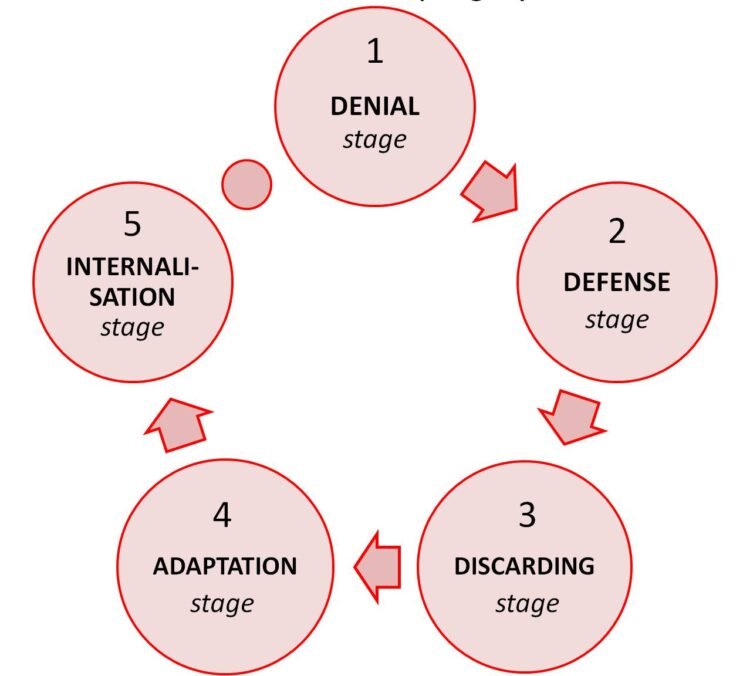
Colin Carnall’s Coping Cycle Model of Change Management

In the field of psychology, numerous models and theories have been developed to explain how individuals cope with various challenges and stressors in their lives. One such model is Colin Carnall’s Coping Cycle Model, which identifies five stages that individuals go through when faced with difficult situations. Carnall’s Coping Cycle Model consists of five stages — denial, defense, discarding, adaptation, and internalization — which are explained in detail, shedding light on their significance and implications. Denial – The first stage of Carnall’s Coping Cycle Model is denial. During this stage, individuals tend to resist or ignore the reality of a challenging situation. Denial acts as a protective mechanism, shielding individuals from the initial shock and emotional distress associated with the situation. However, it is important to note that denial is usually temporary and serves as a starting point for individuals to process the situation further. Defense – The second stage, Continue reading