Retail Formats or Classification of Retail Firms

Retailing is to provide services and products and at a profit. Retailing consists of the sale of goods for personal or household consumption operating from an appropriate location offering wide range of access to its target audience. There are immense ways and places in which retail may be conducting in current business environment, however the aim of all types of retails is to engage with customer effectively and achieve the organization aims and objectives through the various strategies that may suit them.  Regardless of the particular type of retailer (such as a supermarket or a department store), retailers can be categorized by (a) Ownership, (b) Store strategy mix, and (c) Non store operations. 1. Form of Ownership A retail business like any other type of business, can be owned by a sole proprietor, partners or a corporation. A majority of retail business in India are sole proprietorships and partnerships. Independent Continue reading
Quality Management Tools: Pareto Analysis

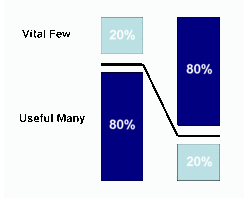
Pareto analysis is a very simple technique that helps a manager to choose the most effective changes to make. It is represented as a bar graph used to arrange information in such a way that priorities for process improvement can be established. Pareto charts are constructed to provide a before-and-after comparison of the effect of control or quality improvement measures. The Pareto Effect The 80:20 theory was first developed in 1906, by an Italian economist, Vilfredo Pareto, who observed an unequal distribution of wealth and power in a relatively small proportion of the total population. This fact gave rise to the Pareto effect or Pareto’s law: a small proportion of causes produce a large proportion of results. Thus frequently a vital few causes may need special attention wile the trivial many may warrant very little. It is this phrase that is most commonly used in talking about the Pareto effect Continue reading

The Benefits and Harms of Advertising

The Benefits of Advertising Enormous human and material resources are devoted to advertising. Advertising is everywhere in today’s world, so that, as Pope Paul VI remarked, “No one now can escape the influence of advertising.” Even people who are not themselves exposed to particular forms of advertising confront a society, a culture – other people – affected for good or ill by advertising messages and techniques of every sort. Some critics view this state of affairs in unrelieved negative terms. They condemn advertising as a waste of time, talent and money – an essentially parasitic activity. In this view, not only does advertising have no value of its own, but also its influence is entirely harmful and corrupting for individuals and society. But advertising also has significant potential for good, and sometimes it is realized. Here are some of the ways that happens. Economic Benefits of Advertising Advertising can play Continue reading

Goldratt’s Theory of Constraints – Constraint Management

An Israeli physicist, Eliyahu Goldratt wrote a book titled ‘The Goal’, about a factory manager’s quest to save his factory from being closed down for lack of profitability. It chronicles the process that the manager and his staff go through as they learn how to save their factory. What they learn is how to apply the principles of what Mr. Goldratt calls the “Theory of Constraints.” Theory of Constraints (TOC) is a logic-driven  approach which focuses on  system improvement. The core idea of TOC is that every organization has at least one constraint that prevents management from achieving the goal of the organization to a larger degree. A system can be defined as a collection of interrelated, interdependent components or processes that act in concert to turn inputs into defined outputs in pursuit of a particular goal. Linking systems to chains, TOC defines  weakest link as a Constraint. Constraint limits Continue reading

Interior Design Considerations in Retail Store Design

The interior design of the retail store determines the way the merchandise is  stored and offered for sale. The interior design should allow easy access to merchandise  for customer. There are several layout patterns that enhance the customer’s access  to goods. The interior also projects an image to the shopper that should be  consistent with that conveyed by the store’s promotion, price, and merchandise  and with the exterior design. The store interior must make the customer  comfortable and encourage shopping. The objective of layout management is to obtain the maximum benefits  from the space available. There are issues that retail managers should consider  when they make layout decision: 1. Value of Space The value of space, depending on the location within the store, is  expressed in sales per square foot of floor space, and sales per cubic foot of cubic  space. Sales per square foot is the typical measure for Continue reading

The Asian Development Bank (ADB)

Origin During the 1950s, it was strongly felt that there should be a bank for Asia like the World Bank to meet the development needs of this region. This view was suggested for the first time at the ministerial Conference on Asian Cooperation held at Manila in December 1963. The Conference constituted a working group of experts which submitted its report to the UN Economic commission for Asia and Far East (ECAFE) at its session held at Wellington in March 1965. It was on the basis of this report that an Agreement Establishing the Asian Development Bank was drafted and adopted at the Second Ministerial Conference on Asian Economic Cooperation at Manila in November-December 1965. By January 1966, 33 countries had signed its Charter and the Asian Development Bank was set up on December 19, 1966 with its headquarters at Manila in the Philippines. Objectives The main aim for the Continue reading