Income and Substitution Effect Explained

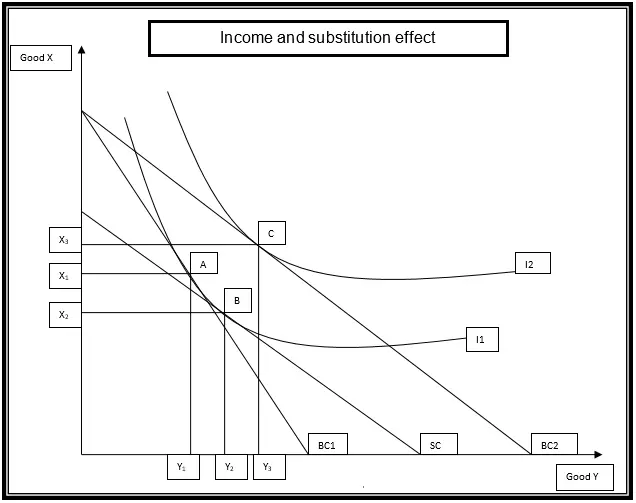
Based on the law of demand, a change in price can be described in terms of income and substitution effect. The diagram presented below will be used to explain these effects. The two items that will be analyzed are commodity Y and X. According to the law of demand, a drop in the price of commodity Y will lead to an increase in quantity demand. The increase will cause the budget line to pivot from BC1 to BC2. Also, the indifference curve will shift from I1 to I2. This represents a movement to a higher indifference curve. The equilibrium position is the point of tangency between the budget line and the indifference curve. When the price of commodity Y falls, a consumer will be indifferent between consumption at point A and B because they lie on the same indifference curve. However, at point B, the consumer shall not have exploited Continue reading

Legal Nature of Trademarks as a Form of Property

There are some laws governing trademarks which give it legal nature. A trademark is treated as an intellectual property. In fact, the law in the USA and other nations including Australia recognizes trademark as a form of property that ought to be guarded. The rights of ownership of the property can be established through registration of the symbol or mark in the patent office or through actual use in the market place. However, most jurisdictions do not recognize the legal ownership of a trademark if the ownership arises through use in the market rather than registration. In the event of infringement of rights associated with the same, the case will be treated on the basis of ‘first one to file.’ The process of registering a trade mark is similar to the process of property registration. This further reveals its legal and property nature. In the first place, the owner is supposed Continue reading

Market Myopia – Meaning, Examples, and Avoidance 

The competitive market is an unstable and ever-evolving medium. Products change, companies rise and fall, and new trends and demands fluctuate from one point to another. In this environment, a business cannot allow itself to remain static unless it wants to be swept away by its competitors. Large companies have, arguably, an easier time facing the winds of business fortune. The big players tend to have resources, brand names, and teams of analysts and planners to prevent and predict every possible fluctuation of the market. Yet many large and successful companies have fallen victim to a trap known as market myopia. What Is Market Myopia? The concept of Market Myopia was first introduced in 1960 by Theodore C. Levitt, a professor of marketing at Harvard Business School. In his article, “Marketing Myopia,” published by Harvard Business Review, he described the mechanism of this faulty approach to marketing. Marketing Myopia is Continue reading

Growth and Success of an Enterprise – Factors and Stages

There exists several factors which contribute to the growth and success of an enterprise and among the leading factors is the age of the firm. To explain why smaller and younger firms are likely to grow faster than old and large enterprises is explained in economics by the use of the concavity of the production function. Where at the start, the small capital invested has the capability of multiplying exponentially but as time moves on and new investments are injected in to the investment, the marginal rate of productivity of the invested capital declines and that explains the reason why young firms grow faster than old and already established enterprises. Although many experts indicate that as the firm ages the likelihood of it learning form its mistakes and thus succeeding are high, the multiplier effect of large business is low and this is a major contributor to the success of an Continue reading

Digital Transformation – Definition, Types, Challenges, and Examples

Business performance improvement is a core goal of organizations. They develop core capabilities that drive a sustained transformation to achieve the set strategic objectives. Further, high-performance firms adopt policies for change management and adaptation to remain competitive in an unpredictable business environment. One capability that impact organizational performance is information technology (IT). Significant competitive gains are linked to superior IT resources that support digital business. Strategic integration of IT into organizational processes is seen as a way to promote greater digitization and transform a firm. IT-driven transformation encompasses the competitive capabilities drawn from information technology. The transformational potential of IT is seen in business processes, relations, consumer experience, clients, and disruption. Thus, a fundamental characteristic of digital transformation is the ability to change traditional models or confer new capabilities. The technologies should alter firm operations, support expansion to different markets or customers, and yield competitive gains. Conceptually, digital transformation encompasses Continue reading

Case Study: Human Resources Management Practices at Volvo’s Uddevalla Plant

The state in which the Human Resources Management is in a certain company predetermines the success and the level of the market competitiveness of any company, that is why companies all over the world are interested in the recruitment of skillful staff managers who can improve their work. This case study is discussing the experience of the Volvo Plant in Uddevalla, Sweden as the brightest example of how the improved management can take the company’s competitiveness in the market to a higher level. We are going to discuss the main principles used in the work of the Volvo Plant, see how effective they were and if they are possible to implement at other companies in the sphere of car assembly. To begin with, let us state that the experiences of the Uddevalla Volvo Plant have taught many lessons to the management of the Volvo Company itself, other car-producing companies, and Continue reading