The Nadler-Tushman Congruence Model

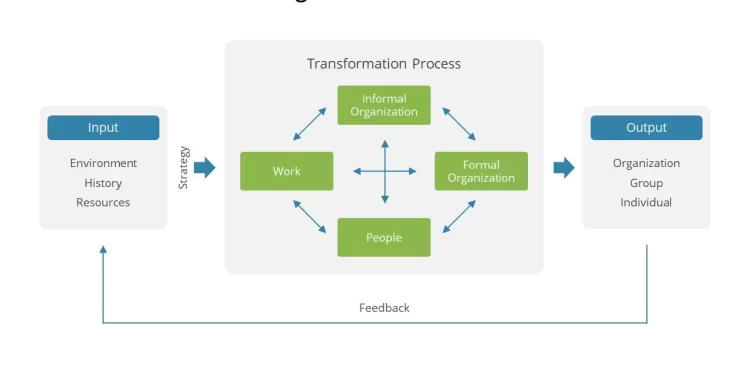
The main responsibility of the management is to ensure smooth operations of a firm. In addition, the management must ensure that the goals being pursued by the organization are attained. Essentially, the goals of the organization can only be reached when the inputs are transformed into the final products and services. In other words, the major function of the management is to ensure that they put in place strategies that will ensure effective transformation of the organization’s inputs into the desired outputs. In addition, the management must also be efficient in all other operations related to the company’s functioning. However, managing the organization effectively has remained a challenge for the most of managers. Understanding the dynamics occurring within the organization including the group and individual behaviors, changing processes as well as the relationships that exist between the processes is complex . Despite the complexity of these processes, the changes occurring Continue reading

Five Stages Of Grief – Understanding the Kübler-Ross Model

The Kübler-Ross model has shaped the ways in many psychologists and therapists think about grief, bereavement, and dying. The greatest appeal of this approach is that it describes the behavior of a person as a set of different reactions, namely denial, anger, bargaining, depression, and acceptance. By applying this framework, a therapist can believe that the behavior of a person can be more manageable and predictable. Thus, it has significant implications for the counseling of many patients. In particular, it is necessary to demonstrate that the stages identified by Dr. Elizabeth Kübler-Ross are not always consecutive as some people may believe. Secondly, some of these responses may not be present at all. Finally, the experiences of a person in such stressful situations cannot be reduced only to denial, bargaining, anger, depression or acceptance. To a great extent, they depend on the immediate environment of an individual. These are the main ideas Continue reading

Advantages and Limitations of Prosci ADKAR Model

There are a number of models in management that aim to reduce resistance to change and control most organizational change processes. The Prosci ADKAR model is one of the best approaches introduced several years ago to support change in companies through the prism of its five major elements, namely awareness, desire, knowledge, ability, and reinforcement. The progress of the ADKAR model is evident today due to its evident advantages and the possibility to facilitate working processes. This model is developed from a study of 900 organizations across 59 countries over a 14-year period, carried out by the American research organization, Prosci. This model, developed by Jeff Hiatt, and first published in 2003, focuses on participatory approach of dealing with change. The model is simple to learn, makes sense, and focuses on the actions and outcomes required for change. ADKAR, in contrast to most other change management models, focuses on the human aspect Continue reading

Case Study: Starbucks Survival From the Financial Crisis of 2008

The beginning of the economic crisis of 2008 significantly affected all businesses throughout the country, and this event influenced the companies involved in international operations in the first place. For example, Starbucks faced challenges stemming from the emerging hardships expressed by financial losses and wrong strategic choices, deteriorating its overall position in the market. However, the managers’ external circumstances were not the most critical considerations since the existing problems in Starbucks’ activity were added to the new issues. The failure to adhere to the company’s original vision related to providing not simply a product but valuable experiences led to difficulties in overcoming the crisis. From this perspective, the analysis of all conditions as of 2008 is required to demonstrate Starbucks’ capability to survive in the future. The Company During the Economic Crisis of 2008 During the economic crisis of 2008, Starbucks’ managers were reported to struggle with maintaining operations while Continue reading

Market Economy – Overview, Features, Characteristics, Advantages and Disadvantages

A market economy can be defined as an economy in which the allocation of resources is determined only by their supply and the demand for them. Market economy can also be defined as an economic system in which economic decisions and the pricing of goods and services are guided solely by the aggregate interactions of a country’s citizens and businesses and there is little government intervention or central planning. To conclude, the market economic system is basically a system whereby private individuals take up the responsibility of allocating resources to the public and relies chiefly on market forces to determine prices. Countries practicing the market economic system tend to assume that the forces of demand and supply are the main determinants of what is right for a nation’s well-being. They {the countries} rarely experience government interventions such as price fixing, license quotas and industry subsidizations. In reality, the market economy Continue reading

Monopsony and Competition Law in Indian Context

Can a buyer be the biggest bully? The classical theory of monopsony answers this question. It envisions a market scenario with only one buyer, who can use his leverage to reduce the quantity of product purchased, thereby driving down the price that he has to pay. Seldom does a monopsonistic situation arise in the market, so much so that little has been thought till date about the potential adverse impact of such a scenario on market competition. Another reason for the antitrust analyst’s apparent neglect of the power on the buyer’s side of the market may be that such power tends to reduce the selling price of a commodity, thereby causing a prima facie increase in consumer welfare, which has always been one of the traditional goals of competition law. Classical Monopsony -What does It Entail? Pure monopsony can be looked upon as the demand-side analogue of the monopolist who Continue reading