Business Code of Ethics – Development and Importance

Need for Business Code of Ethics There are many regulations and polices in place that set the minimum standards for ethical business behavior. Unfortunately, businesses still partake in unethical behaviors. Unethical behavior in a business can have many effects on the organization. Over the years, there have been several business scandals that have tarnished the credulity of their business. As a result of their unethical behavior, businesses have lost loyal customers and potential investors.  Customers no longer trust the business and what they have to offer. It is important for companies to have an ethics program in place that will outline ethical business behaviors and their code of ethics. This will ultimately reduce and prevent unethical behaviors within a business. The employees have committed many unethical acts due to their lack of a code of ethics and an ethics program. They are unaware of what is expected of them so, Continue reading

Top Reasons To Hire Professionals To Create Your Customer Journey

Designing a customer journey is a nuanced process that influences how a consumer interacts with your brand from initial discovery to final transaction. Studies show that companies with well-mapped customer journeys achieve a 54% greater return on marketing investments than those without. Engaging professionals to create your customer journey can transform a casual browser into a loyal customer, boosting both satisfaction and revenue. Hiring experts offers the advantage of incorporating industry best practices and innovative strategies into your customer journey. This article delves into why professional assistance isn’t just beneficial but often a key differentiator in today’s competitive markets. Below, we explore the top reasons to partner with pros for mapping your customers’ path to purchase. Crafting the Ideal Customer Journey With Professional Expertise Establishing a coherent customer journey is an art form, perfected with professional expertise. Specialists in customer experience use their knowledge to design engaging touchpoints tailored to Continue reading

Case Study: Balancing Culture and Growth at Starbucks

Howard Schultz built Starbucks into one of the most successful companies in the United States. Indeed, Starbucks has joined such other iconic American corporations as Disney and McDonald’s in spreading its brand across the globe. Indeed, Schultz has come to symbolize a new breed of high successful entrepreneurs. His 2000 memoir, Pour Your Heart into It: How Starbucks Built a Company One Cup at a Time, became an instant best-seller. People can be forgiven if they believe Schultz was the company’s founder, but this is not the case. Starbucks, in fact, was founded in 1971. It was already a thriving, albeit small, coffee bean market in Seattle’s Pike Place Market when Schultz first dropped in. At the time, he was selling kitchenware for a Swedish manufacturer. It was, he claims, love at first smell. In 1982, he moved to Seattle and joined the company as director of retail operations. A visit Continue reading

Case Study: Analyzing Kodak’s Business Failure

Eastman Kodak is in most certainty the story of an organization that has failed to correctly manage and implement change. The company which was enjoying sales of around US$10 billion in 1981 has a net income of only US$139 million in 2005. Kodak’s brand value also slipped down dramatically. An estimated US$2.6 billion was lost owing to the decrease in organization’s brand value. A number of factors played an important role in Eastman Kodak’s tragic decline. The most important factor that contributed to Kodak’s demise was the rigid thinking on part of its management that stopped them from taking timely initiative towards adoption of digital technology in digital communications segment of the company. Another important letdown related to change implementation occurred when Kodak’s management failed to realize that it needs to continuously monitor the changes occurring in the environment and then take small continuous steps towards complete adoption of a Continue reading

What is Transformational Leadership?

In any organization, the focus is based on yielding high profits. The key to this lies in the leader, who in turn inspires the staff. Leadership in an organization is usually classified into different categories based on the style the leader uses. Different leadership styles are used to attain desired goals, but the secret to an organization that is effective in achieving its goals lies in the use of transformational leadership. A leader usually uses power and influence to exercise authority. In transformational leadership, however, the idea is to emphasize influence to manage the teams and bring them aboard to understand the leader’s vision. Transformational leadership can be defined as implementing new ideas through adopting a more flexible and universal method of influencing and continually ameliorating those around them. This type of leadership calls for the leader and the staff to improve one another’s motivation levels. Motivational leaders bravely work towards making Continue reading

The Significance of Price Elasticity of Demand

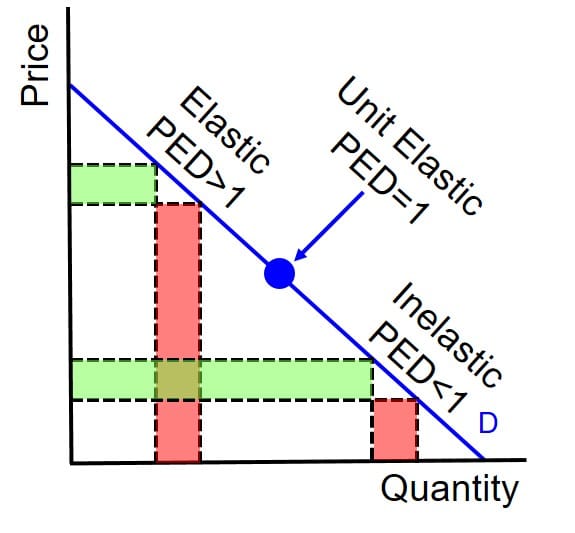
Price elasticity of demand (PED) is a measure of the responsiveness of change in quantity demanded of a good/service to a change in price, ceteris paribus. As the law of demand indicates, when the price of a good/service increases, the demand of it will decrease. Conversely, when the price of a product decreases, the demand of the product will increase. However, the extent to which a price change impacts the demand differs widely from produce to product. PED=(change in quantity demanded)/(change in price). If this value is bigger than one, the product is said to be price elastic (price sensitive), whereby a change in price will lead to a greater than proportionate change in quantity demanded. If the PED is smaller than one, the product will be price inelastic (price insensitive), where a percentage change in price will lead to a smaller percentage change in quantity demanded. And when PED=1, Continue reading