Concepts of Ethical Consumerism and Consumer Activism

Concept of Ethical Consumerism Over the last ten or twenty years, more and more people around the world, primarily in industrialized countries, have become better informed and more aware of the origins of the goods they purchase on a day-to-day basis, the buying policies and practices of the shops they visit and the policies and principles of the services they buy. In a growing number of cases, this increased awareness and knowledge is affecting consumer practices and may be the difference between someone buying a particular product or service or not. There are a number of reasons for this development, which is commonly referred to as “ethical consumerism”, or also “ethical consumption”, “ethical purchasing”, “moral purchasing”, “ethical sourcing”, “ethical shopping” or “green consumerism”. Fundamentally, ethical consumerism is consumers taking responsibility for their decisions in purchasing goods and services. Two key elements that have contributed to this development and that are Continue reading

Design and Placement of the Corporate Communication Function

The need to centralize or decentralize usually comes down to weighing the considerations of company size, product, or service diversity, and geographic spread. For a company as diverse and large as General Electric, for example, the question was moot. Such a huge, diverse organization involved in activities as different as aerospace and network television cannot possibly remain completely centralized in all of its communication activities. Perhaps then, the best structure for large companies is some combination of a strong, centralized, functional area plus a network of decentralized operatives helping to keep communications consistent throughout the organization while adapting the function to the special needs of the independent business unit. Despite its advantages, the mix of centralized and decentralized activities presents problems for organizations in terms of reporting relationships. If the communications operatives report to their local managers, as they inevitably would, they will run into problems when the manager from Continue reading

Financial Leverage and the Shareholders Risk

It has is seen that financial leverage magnifies the shareholder’s earnings. It has also been observed that the variability of EBIT causes EPS to fluctuate within wider ranges with debt in the capital structure. That is, with more debt, EPS rises and falls faster than the rise and fall of EBIT. Thus, financial leverage not only magnifies EPS but also increases its variability. The variability of EBIT and EPS distinguish between two types of risk- operating risk and financial risk. 1. Operating Risk- Operating risk can be defined as the variability of EBIT (or return on assets). The environment- internal and external- in which a firm operates determines the variability of EBIT. So long as the environment is given to the firm, operating risk is an unavoidable risk. A firm is better placed to face such risk if it can predict it with a fair degree of accuracy. The variability Continue reading

Harmon’s Process-Strategy Matrix

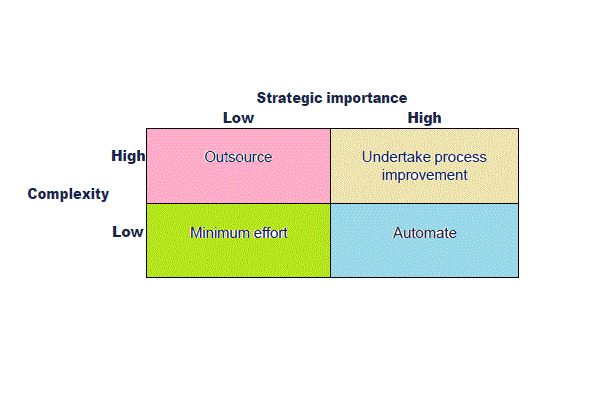
Process-Strategy matrix by Paul Harmon will be useful in deciding how the process should be managed, it gives two variable one Is importance and other is complexity and dynamics. There may be other variables to consider in practice such as culture, cost and savings and quality. It should be used flexibly by considering all the variable affecting the current and future prospects of the organization. Advantages and disadvantages should be considered before reaching the final decision. How To Assess The strategic Importance? Strategic importance can be assessed by asking what would happen if a process is abandoned. If it impacts the business objective (Quality, cost control and reputation etc.) materially (more than insignificant) than it can be assessed as high strategic importance like threatening to the survival of business. Strategic importance can also be assessed by identifying key stakeholders. If the process affecting the key stakeholders like customers, Tax authorities Continue reading

Economic Systems – Planned Economy, Free Market Economy and Mixed Economy

System of Planned Economy Under the conditions of the planned economy, all decisions concerning what to manufacture, how to manufacture and to whom to manufacture are approved by the sole center or group. This economy is based on collective ownership. Fixed production assets are owned by the government, and resources, production and the quantities of future products are distributed according to a plan. The type of the system of the command economy was prevailing in the USSR, Cuba, and North Korea. The plans of the system of the centralized economy are drawn up and implemented by the authorities and governmental political leaders after consulting with highly ranked professionals: engineers, economists, industrialists, and other experts. These planners decide which products to manufacture and which services to render. Their vote is decisive in approving decisions whether new undertakings are to be constructed, how many employees are to be employed at undertakings, whether Continue reading

Laws of Returns in Economics

The relationship between the inputs and the output in the process of production is clearly explained by the Laws of Returns or the Law of Variable Proportions.   This law examines the production function with only one factor variable, keeping the quantities of other factors constant.   The laws of returns comprise of three phases: The Law of Increasing Returns. The Law of Constant Returns. The Law of Diminishing Returns. The Laws of Returns in Economics may be stated as follows: “If in any process of production, the factors of production are so combined that if the varying quantity of one factor is combined with the fixed quantity of other factor (or factors), then there will be three tendencies about the additional output or marginal returns: Firstly, in the beginning, as more and more units of a variable factor are added to the units of a fixed factor, the additional Continue reading