
The early 1980s saw the emergence of a new school of thought that emphasized the impact of aggregate supply on the economic growth of nations. This new school of thought was called supply-side economics. Supply-side economists argued that creating an economic environment that provided incentives for people to work and save money, and also an environment that is conducive for firms to invest and create employment would cause an increase in aggregate supply. The supply-side economists assumed that the aggregate demand of the nation was always adequate and that it would absorb the aggregate supply, thus indicating their acceptance of Say’s law. Supply-side economics, thus, laid emphasis on reduction in tax-rates and social spending, promotion of free labor markets and liberalization of economy. The supply-side economists believed that incentives and tax-rates influence the economy’s aggregate supply to a great extent. According to them, the tax-rates induce people either to produce Continue reading
Economics Concepts
Price Discrimination – Meaning and Definition
Often do we come across situations when we find that a single producer sells his product at different prices to different buyers or in different markets. This practice of charging different prices to different buyers or in different markets for the same product is called Price discrimination. According to British economist Joan Robinson, “the act of selling the same article, produced under a single control, at different prices to different buyers is called Price discrimination.” Price discrimination is a practice firms employ when they charge consumers different prices for the same good in order to earn higher profits. Price discrimination is made possible because of varying utility derived from the consumption of the same good and varying price elasticity of demand. There are 3 types of price discrimination, namely: first-degree price discrimination (perfect price discrimination), second-degree price discrimination and third-degree price discrimination. A firm is said to have practiced first-degree Continue reading
Theory of Absolute Advantage and Comparative Advantage
Theory of Absolute Advantage If one region can produce a commodity with less expense than another, and they exchange, then both should benefit. In a nutshell, this is the law of comparative advantage. It is used as the justification for WTO trade regulations. Some land grows corn better than other land. This economical insight into farming in early 18th Century was the cornerstone of the law of absolute advantage. Some farmland will yield more corn per acre than another, therefore the good land confers an absolute advantage over other regions. The conclusion drawn from this argument is that the farmer of the poor land should change products that it can produce to its absolute advantage, such as grazing sheep. The law of absolute advantage is based on the assumption that competition is the best paradigm within which to build an economy, it assumes that competition will improve production. The Continue reading
Profit Maximization Under Price Discrimination
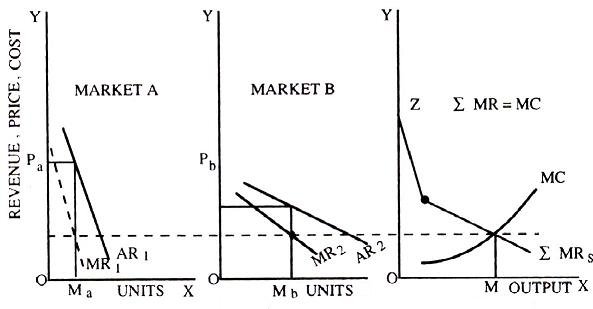
The aim of the discriminating monopolist is to maximize profits. We can thus derive the condition of profit maximization under price-discrimination by extending the normal theory of the firm to a case where there are two or more markets instead of just one market. We can build up the theory of profit maximization on the basis of certain assumptions : There are two markets A and B. The aim of the monopolist is to maximize profits. He enjoys monopoly position in both the markets. The elasticity of demand for the product in the two markets is different (This is perhaps the most essential condition for price discrimination to be profitable). Price discrimination, according to Stonier and Hague “will be profitable only if elasticity of demand in one market is different from elasticity of demand in the other. In general, it will pay a monopolist to discriminate Continue reading
Economic Performance Reports in Business
Reports on the economic performance of business units are quite different. Management reports are prepared monthly or quarterly, whereas economic performance reports are prepared at irregular intervals usually once every several years. For reasons stated earlier, management reports tend to use historical information actual costs incurred, whereas economic reports use quite different information. In this section we discuss the purpose and nature of the economic information. Economic reports are a diagnostic instrument. They indicate whether the current strategies of the business unit are satisfactory and, if not, whether a decision should be made to do something about the business unit- expand it, shrink it, change its direction, or sell it. The economic analysis of an individual business unit may reveal that current plans for new products, new plant and equipment, or other new strategies, when considered as a whole, will not produce a satisfactory future profit, even though, separately each Continue reading
International Trade Theories – Absolute, Comparative and Competitive Advantage
Absolute advantage theory was first presented by Adam Smith in his book “The Wealth of Nations” in 1776. Smith provided the first concept of a nation’s wealth. Adam Smith is a grandfather of economics because he introduced two important concepts that many of the new trade theories are based on these two main concepts, which are specialization and free exchange. However, many arguments were made and many economists thought there was a problem with the theory of absolute advantage after David Ricardo published the theory of “comparative cost” (aka “comparative advantage”) in the early 19th century. Even though Smith and his followers introduced many important points for the thoughts of economic, it is too complicated with this simple version of trade theory in today’s global economy. In 1990, Michael Porter introduced the diamond model of new competitiveness theory. These three trade theories are important in order to make a country Continue reading