
The Google Guys: Inside the Brilliant Minds of Google Founders Larry Page and Sergey Brin by Richard L. Brandt is a guidebook to the inner workings of Google’s founders. Brandt examines the key characteristics that has led Google co-founders, Lawrence Page and Sergey Brin through their progression and subsequent success. The Google Guys explores the beginning of their venture while they were graduate students at Stanford University and through the obstacles that they encountered as they built their empire. Page is scientifically and academically oriented with an undergraduate degree in engineering from the University of Michigan and a Master of Science in computer science. During his doctoral studies at Stanford, he developed BackRub which was the antecedent of PageRank, a complex algorithm that analyses and ranks websites based on quantity and quality of backlinks or website links to another website. PageRank is analogous to citations used in research where a reference source that Continue reading
International Business Management
Phases or Stages of Cultural Adjustment in International Business
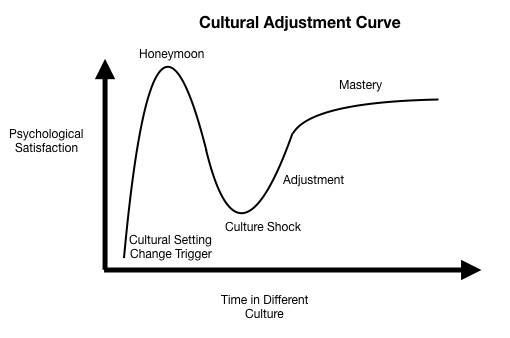
Foreign assignments are usually met with the need for cultural adjustments by the respective managers. It is important to note that cultural adjustment is a continuing process that imposes new demands when a foreign manager undertakes his duties during the foreign assignment. According to research conducted by Gregory Trivonovitch, there are four distinct phases of cultural adjustment that are cyclic due to the fact an individual persistently encounters a period of adjustment when moving from one cultural context to another. The four stages identified by most models of cultural adjustment for the case of foreign managers include honeymoon, cultural shock, adjustment, and mastery phase. The honeymoon phase of cultural adjustment is characterized by a positive perception of the cultural differences between the home and host cultural values. This is usually due to an increased fascination concerning the new cultural aspects such as new types of foods, types of buildings, individual Continue reading
Integration of AI on Strategic Decision Making in Multinational Corporations
Artificial intelligence (AI) has emerged as a transformative technology with far-reaching implications across industries and business functions. For multinational corporations (MNCs) operating in complex global environments, AI presents both significant opportunities and challenges when it comes to strategic decision making. While AI can dramatically enhance decision making capabilities in areas like data analysis, forecasting, and operational optimization, human judgment and oversight remain essential, particularly for high-stakes strategic decisions in uncertain environments. Ultimately, it will contend that MNCs which can effectively combine AI-driven insights with human expertise and judgment will gain significant competitive advantages in strategic decision making. AI Capabilities Enhancing Strategic Decision Making AI technologies offer MNCs powerful new capabilities to augment and enhance strategic decision making processes. One of the most significant impacts is AI’s ability to rapidly analyze vast amounts of complex data to uncover insights and patterns that would be difficult or impossible for humans to detect. Continue reading
US vs. Japanese Corporate Philosophy and Strategies Analysis
With the advent of the word ‘Americanization’, management ideas and practices started evolving and influencing other nations of the world. However, there still is no doubt that during the 1970s and 1980s, Japanese firms under ‘capitalism’ type of Japanese Management System achieved better performance than their American competitor, counterpart and teacher. Japanese firms differed characteristically from the latter in such areas as owner-manager relations, industrial relations, inter-firm relations and business-government relations. Ironically, from the start of the 1990s, just after the Japanese Asset Price Bubble (1986-1990) era, firms and capitalism in Japan deteriorated in their performance. They then again found themselves under the influence of the United States, this time they named it ‘Re-Americanization’. Initially the 1990s for the Japanese Management System was followed by the imitation of American business and capitalism which extended to all functions of Japanese firms and all aspects of capitalism. At the individual firm level, Continue reading
Theoretical Perspectives on Culture Shock Concept in International Business
The word “Culture Shock” was first introduced by world-renowned anthropologist Kalervo Oberg in 1960. He used the word culture shock to describe the anxiety resulting from not knowing what to do in new culture. Oberg defined culture “as occupational disease of people who have suddenly been transported abroad” and suggested that culture shock is “precipitated by the anxiety that result from losing all our familiar signs and symbol of social intercourse.” In other words the term culture shock refers to the situation where an individual migrates from a culture to which he/she is familiar with to an unfamiliar one resulting in new experiences and causing distress and discomfort or sense of loneliness. Oberg’s definition on culture shock was supported by many renowned scholars. For example, Hofstede has also defined culture shock as a “stress of distress following the transfer of a person to an unfamiliar cultural environment. Furthermore, Alder (1975) Continue reading
How to Gain Rights in a Trademark?

The concept of a trademark has gained massive popularity in the modern business environment. Trademark is defined as a word, phrase, or logo that identifies the source of goods or services. As the name suggests, it is a mark that identifies a company and distinguishes it from its rivals in the market. The concept of defining the identity of business emerged because of the existence of companies offering similar products in the same environment. It is prudent for a company to register its trademark to avoid cases where its brand image and name is abused by unethical business entities or individuals. Each country has its legal system that defines what a company needs to do to have a right to a given trademark. Although there may be variations from one country to another, it is a universally accepted practice for one to register a given trademark to have exclusive rights Continue reading