A major driving force for supply chain in the 21st century are globalization and technology. Globalization has resulted in supply chains being stretched across the world, particularly with production shifting to cheaper labor markets while major consumers remain in affluent Western regions. To facilitate the depth and scope of these extensive supply chains, transportation became critical to supply chain management, figuratively described as the “glue” and “life blood” of global supply chains, vital to growth and development of businesses and economies as a whole. Transportation is the most critical industry in an industrialized society, as a tool without which no element of the economy would be able to function, ranging from a grocery store to a factory. The more complex the economy, business, or company – the more indispensable an efficient and effective transportation system becomes. Logistics is an element of supply chain management that plans, implements, and controls the Continue reading
Logistics Concepts
Applications of Artificial Intelligence in the Transportation Industry
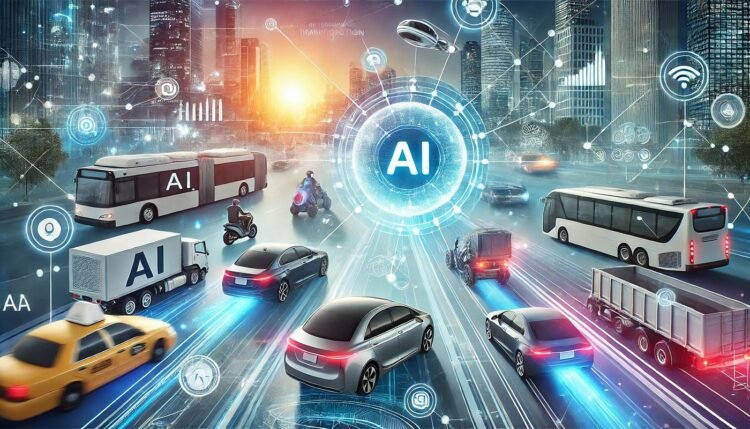
Transportation, the business of moving goods and people from one location to another, has undergone several studies, research, experiments, and modifications to get to where it is now. In the year 1787, the steamboat became one of the most significant milestones in the history of transportation. Previously, people had to rely on animal-drawn carts to go about. Following that, key achievements in the transportation business included the introduction of bicycles in the early nineteenth century, automobiles in the 1890s, railroads in the nineteenth century, and airplanes in the twentieth century. The transportation industry has progressed to the point where vehicles can navigate and move without the need for human intervention. The industry has benefited from technological breakthroughs in its quest for innovation and evolution. Artificial intelligence (AI) is one such cutting-edge technology that has benefited the industry. Leveraging AI in transportation helps the industry improve passenger safety, reduce traffic congestion and Continue reading
Distribution Center Decisions

When deciding upon locational decision a manager basically decides upon suppliers, plants, ware houses and markets. There may also be other facilities such as super stockists, consolidation centers or transit points. Besides locating the facilities a manager must also decide how market may be allocated to ware houses and how ware houses will be allocated to plants. The allocation decision can be altered on a regular basis as different costs change and markets evolve. When designing the network, both location and allocation decisions are made jointly. In some cases, companies want to design supply chain networks, in which a market is supplied from only one factory. This is commonly known as the capacitated plant location model with single sources. Companies may impose this constraint because it lower the complexity of coordinating the network and requires less flexibility from each Facility. A much more general form of the plant location model Continue reading
Competition in Shipping Industry
Shipping is a competitive industry. The demand for shipping services is a derived one. Shipping services do not have alternative applications. So amongst ship owners competition arises to corner the existing traffic. The causes for the competition are as follows: Freedom of use of a certain highways: The permanent way of ocean being a gift of nature, which is free. It is open to all persons and countries of the world without acquiring any rights to float the ships and steamers. Except for some restrictions in coastal waters of the countries, the ship are free to move anywhere on the sea and it invites international competitors. Small investment: Shipping requires small investment to start the sailings. The capital investment in construction of permanent way, signals, bridges, tunnels, culverts and platforms etc is not there in purchasing a steamer or a ship. The facilities of loading, unloading and harboring are maintained Continue reading
Reverse Logistics Process Formalization
Reverse logistics is the process of planning, implementing and controlling the efficient, cost-effective flow of raw materials, in-process inventory, finished goods and related information from the point of consumption to the point of origin for the purpose of recapturing or creating value or for proper disposal. Despite the growing recognition of the importance of reverse logistics, many companies are not ready to meet the challenges involved in handling returns. The rapid growth in the volume of returns far outpaces the abilities of firms to successfully manage the returns. Because of all the uncertainties involved, reverse logistics program development and implementation becomes very complex. The major challenges involve the considerable number of unknowns that have to be accounted for in developing reverse logistics programs. The process of measuring and analyzing returns-related performance criteria is aimed at improving reverse logistics quality and identifying potential problem areas. The following metrics were identified by Continue reading
Export/Import Transportation Systems

The transportation industry is a complex of institution that includes not only the carriers themselves (the ocean shipping companies, airlines, and truckers), but also the supporting terminal operators, freight forwarders, customhouse brokers, ship brokers, financial houses, insurance firms, and engineering and manufacturing concerns, There is also an array of governmental agencies, that oversee the operations of the industry and control the rates charged and services provided. Changes in any of these institutions or their foreign counterparts have ramifications on the rest of the industry and affect the service provided to the shipper of goods in international trade. Physical distribution managers have an array of alternative methods or modes of transportation for the movement of goods across borders and within countries. Various forms of sea, air, and land transportation may be available for use singly or in combination. The manager’s choice is influenced by the specific product and market characteristics. Large, Continue reading