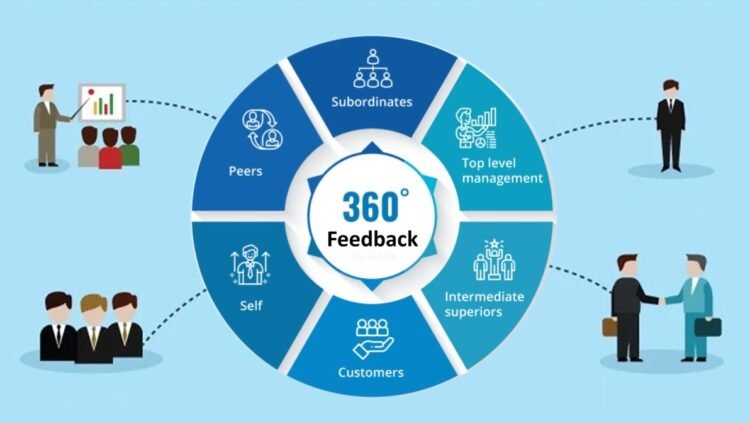
Meaning and Process of 360 Degree Performance Evaluation Performance evaluations are an official interaction between managers and employees in which the manager assesses job performance and discusses in detail strengths, weaknesses and opportunities for development of the employee. Performance reviews serve as an important part of a human resource management systems. Measuring job performance, developing leadership skills, and designing a career path are the major uses of performance appraisal. Ideally, management conducts appraisals in an objective, consistent, and fair way. There are different forms of appraisals that organizations may choose to employ, including, 360 degree performance evaluation, management by objectives and a rating scale. A 360 degree performance evaluation (sometimes referred to as 360-degree feedback), utilizes input from oneself, colleagues, subordinates, and customers, as well as managerial feedback to complete the appraisal of job performance. The philosophy behind gaining feedback from a self-assessment and a variety of additional sources is Continue reading
Modern HRM
Purposes of Performance Management System

Performance Management is often a misunderstood concept most people associate it with concepts such as: Performance appraisal, Performance-related pay, Targets and objectives, Motivation and discipline. But, performance management is much more than this. Performance management is about getting results. It is concerned with getting the best from people and helping them to achieve their potential. It is an approach to achieving a shared vision of the purpose and aims of the organization. It is concerned with helping individuals and teams achieve their potential and recognize their role in contributing to the goals of the organization. A performance management system consists of the processes used to identify, encourage, measure, evaluate, improve, and reward employee performance at work. Employees’ job performance is an important issue for all employers. However, satisfactory performance does not happen automatically; therefore, it is more likely with a good performance management system. A performance management system serves a Continue reading
Compensation Strategies for Different Workforce Generations
Employees are the most valuable assets of any organization. The main purpose of human resource management (HRM) is to manage the development and performance of people employed in an organization. Some of the important tasks of HRM include attracting and retaining employees with the right skills and abilities, match people to the right positions within an organization and to align employee’s goals and objectives with that of the organizations. All these key tasks are directly or indirectly affected by compensation and benefits plan which the human resource management decides. Compensation and benefits redefines value and success in any workplace. An efficient compensation and benefits strategy is seen as an opportunity by organisations to differentiate them-self from their competitors, who may otherwise take away talented workforce. Hence, organisations need to know the evolving needs of the working population to make sure they offer the most competitive package. Compensation is a major Continue reading
Concept of Human Capital

Liberalization, Privatization and Globalization all over the world, has created the need for quality products and quality service. It in turn necessitated organizations to compete with one another to improve the quality and device cost reduction measures to exist in the industry. That could be done only with the development of human capital which is evidenced by the rapid economic growth of Japan and other East Asian countries. The investment in human capital cannot be easily measured as it differs from one person to another. Basically, when we talk of human capital it refers to the human knowledge, their inner capabilities and creativity. The development of technology cannot be fully utilized without knowledge and skill. The capabilities of the human capital in relation to the needs of the organization should be improved by creating a climate in which the human knowledge, skill, capabilities and creativity can be developed. How do Continue reading
Necessity for Alignment between Corporate Strategy and HR Strategy
Current business environmental forces such as competition, innovation, globalization, technological advancement etc has created major impact on organizational behavior. These changes come in different forms. Sometimes it required to reorganize the structure of the organization and due to this organization may have to introduce new roles and new people. Sometimes it may require to change the culture of the organization. In all these situations HRM function plays a major role. Further recent development of new concepts such as knowledge workers has increased the complexity of HRM function. Nowadays HR has become strategic assets for organizations. From an IT company’s view point intellectual property that is knowledge of the software developers is crucial for their business than the physical asset of the company. This importance has heightened due to the transition of old economic conditions to knowledge based economy where it considers the intellectual property as one of key success factors Continue reading
Best Practices in Recruitment and Selection

A company with the right people with the right skills at the helm can achieve wonders. Conversely, poor or uniformed hiring and recruitment decisions at the top most level can cost a company not only financially, but will have a negative bearing on the organization’s reputation with the stakeholders. Keeping this in mind, the likelihood of future problems can be eliminated if best practices are followed for recruitment and selection activities. Successful businesses are only built by establishing a robust recruitment process as hiring mistakes can be extremely costly and time consuming. The use of best practices in recruitment and selection helps furnish an organization with highly skilled, flexible and motivated employees. The best practices in recruitment and selection processes bring forth systems that are modern, proficient, professional and effective, and ensure that individuals who are recruited demonstrate commitment, ethics, and motivation, eagerness to grow and develop and most Continue reading