Organizations introduce changes through people. Unless the people are willing to accept the need and responsibility for organizational change, intended changes can never be translated into reality. In addition, individuals have to learn to adapt their attitudes and behavioral patterns to constantly changing environments. Management of change involves both individual and organizational change. Individual change is behavioral change, which is determined by individual characteristics of members such as their knowledge, attitudes, beliefs, needs, expectations and skills. It is possible to bring about a total change in an organization by changing behaviors of individual members through participative and educative strategies. Although, the degree of difficulty involved in the change and the time taken to bring about the change will depend on the target of change. The attitudes towards change are largely dependent on the nature of the situation and the manner in which changes are initiated and executed. Changing individual behavior Continue reading
Modern Management Concepts
Stage Gate Process by Robert Cooper Explained
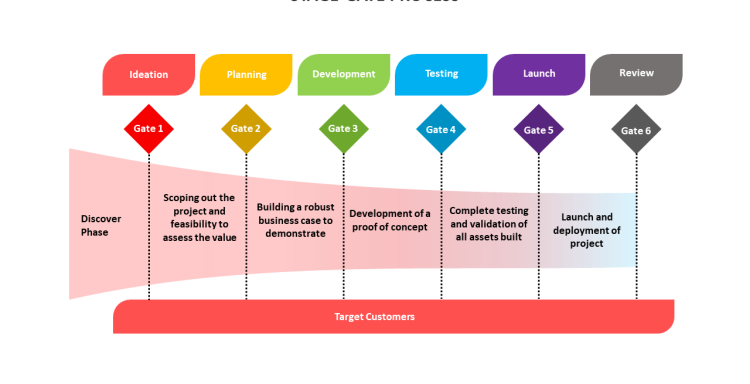
Entrepreneurs use a set of approaches and tools to assess the viability and potential of ideas and profit from them by developing and launching products. Cooper’s Stage Gate Process is one such approach that is key to any product or service in the commercial or non-commercial sector. Cooper’s Stage Gate Process is critical to the processes and performance of an organization as it reduces production errors and therefore saves the company from losses. Cooper’s Stage Gate Process is one of the most frequently used tools in the project development process. This model is based on the fact that any project is broken down into stages that make up a cascade, and to move from one stage to another, managers must go through the “gate”. These gates are critical points for deciding whether to proceed to the next stage. Simultaneously, decisions made at these gates have such options as “go”, “kill”, Continue reading
Blending Spiritual Values with Business
The root for value is valor, which means strength. Values are sources of strength because they give people the power to take action. Values are deep and emotional and often difficult to change. Values are the essence of any organization and philosophy for achieving success. Values provide employees with a sense of common direction and guidelines for day to day behavior. The first step in creating an atmosphere of common commitment is to invite the hearts and minds of employees to join the purpose of the organization. Shared missions, values and vision bring people together. They unite and provide the link between diverse people and activities. People who share values or vision are more likely to take responsibility; they are more likely to challenge the limits of convention. Values provide guidance. Spiritual value is a way of expressing more humanity and recognizes each persons own beliefs. Traditional ways of achieving Continue reading
Impacts of Internet on Entrepreneur Ventures

In recent years, internet is more and more popular and closely to people in a variable fields. Internet was used as a tool for helping them to connect and seeking information or advising what they need. Almost entrepreneurs also use this tool as a part of creating successfully for their business but sometimes it also creates some problem. Some negative impacts of internet on the entrepreneur venture such as security or lost productivity that make the entrepreneur take a lot of problem. However, almost impacts of internet on entrepreneurial ventures is good such as raise the capacity of accessing information through internet, increase communicate capability among entrepreneurs and others people, help to achieve the target specific venture firm, increase the efficiency of the submission process and specially support marketing strategy. Firstly, the most effective impact of internet is the security of the information. Many businesses conducted online get the trouble Continue reading
Cognitive Mapping – A Mental Representation Technique

In 1947, Edward C. Tolman at the University of California at Berkeley, was doing experiments demonstrating that complex internal cognitive activity occurred even in rats and that these mental processes could be studied without the necessity of observing them directly. He proposed that rats have a cognitive map; that ‘in the course of learning,something like a field map of the environment gets established in the rat’s brain… And it is this tentative map, indicating routes and paths and environmental relationships, which finally determines what responses, if any, the animal will finally release.’ [Tolman, 1948, p 192] Due to the significance of his work, Tolman is considered to be the founder of a school of thought about learning that is today called cognitive-behaviorism. A cognitive map in the trivial sense is whatever mental or neural mechanism enables an animal to navigate. On this usage, it is tautologous that animals capable of Continue reading
Leader’s Role in Being a Catalyst for Organization Change
It takes considerable amount of effort and time to set up an organization and get into particular mode of operation. In order to sustain and continuously climb up the ladder of growth, companies need to be lean, flexible and ready to change constantly to implement new processes, introduce or close down particular product lines, incorporate faster technologies, make strategic shifts and decisions thus stimulating creativity, learning, diversity and growth. While the change is inevitable and its need being clearly understood, resistance and adverse affects are also likely to emerge. The important factor in execution of a successful change is that it should be properly planned/ focused along with a high degree of commitment Leadership. A Leader for any organization can be identified as a Spark plug who, because of high energy, good communication and motivational skills, and a can-do attitude, helps realizing important objectives. The leader is the catalyst that Continue reading