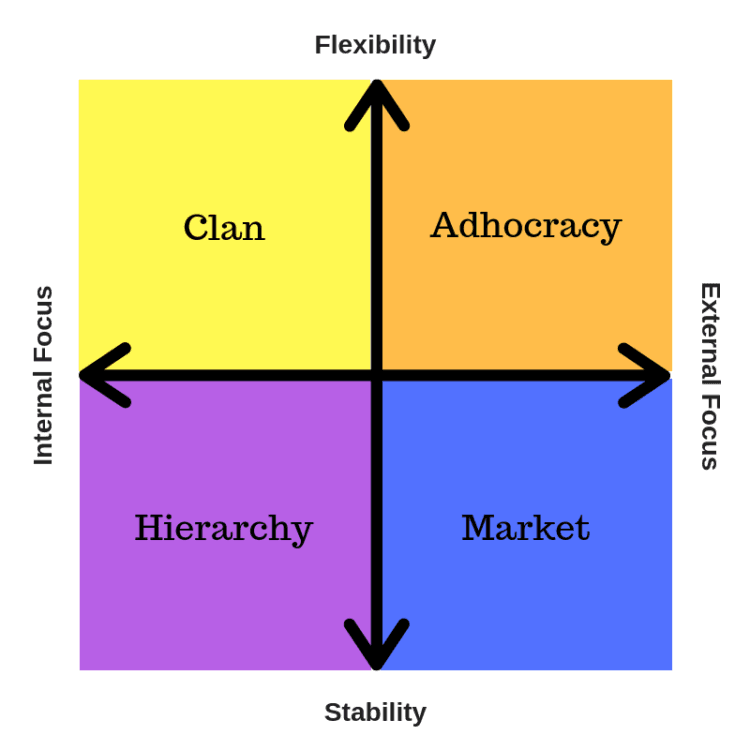
When coming into or starting an organization, many things need to be decided upon for that organization. The organization’s mission statement, its business plan, and its structure are a few of the many things that need to be decided for that organization. One element that is extremely important to establish within an organization is the organization’s culture. An organization’s culture is extremely significant within an organization, and an organization’s culture can be determined from a variety of different types of cultures. Organizational culture can also be called a corporate culture and is defined as the set of shared, taken-for-granted implicit assumptions that a group holds and that determines how it perceives, thinks about, and reacts to its various environments. Each and every organization has its own type of organizational culture that sets it apart from other organizations. One reason organizational culture is vital to an organization is because the type Continue reading
Organizational Behavior
Five Important Organizational Cultural Models
Culture is often said “to eat strategy for breakfast” the implication that, regardless of how good a strategy is, unless specific initiatives are concentrated on changing people’s attitudes, behaviours and work practices, the strategy will fail. Understanding culture of an organisation can be quite the task especially in large companies with a number of employees and staff being very diverse culturally. With the help of Cultural Models, understanding the cultural situation becomes easier. Following are some of the existing Cultural Models. 1. Edgar Schein’s Model Edgar Schein’s model is one such which helps interpret what the cultural position is within the firm. To Schein, culture is dynamic and multi-faceted; it cannot be easily judged as good/bad, strong/weak, or effective/ineffective. Culture is contextual and lives within us as individuals as well as within groups of people. Edgar Schein believed that as employees go through various changes and adapt to the external Continue reading
The Kübler-Ross Change Curve Model
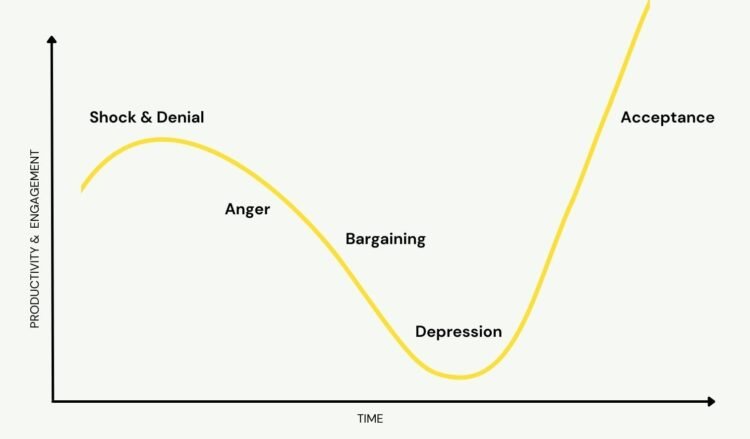
Kübler-Ross’ Five Stage Change Curve Model, also known as the Kübler-Ross Change Model or the Change Curve, is a framework that outlines the emotional stages individuals typically go through when facing significant change. The Change Curve is based on a model originally developed in the 1960s by Dr. Elisabeth Kubler-Ross to explain the grieving process. Since then it has been widely utilized as a method of helping people understand their reactions to significant change or upheaval. Kubler-Ross proposed that a terminally ill patient would progress through five stages of grief when informed of their illness. She further proposed that this model could be applied to any dramatic life changing situation and, by the 1980s, the Change Curve was a firm fixture in change management circles. The curve, and its associated emotions, can be used to predict how performance is likely to be affected by the announcement and subsequent implementation of a Continue reading
Attitudes – Definition, Components, Sources and Types

Attitudes can be defined as an individual’s feelings about or inclinations towards other persons, objects, events, or activities. Attitudes encompass such affective feelings as likes and dislikes, and satisfactions and dissatisfactions. Our needs, past experiences, self-concept, and personality shape the beliefs, feelings, and opinion we hold towards the perceived world. Once we have formed our likes and dislikes, we generally cling on to them and find it difficult to change our attitudes, unless we make a conscious and determined effort to do so. An interesting phenomenon is that our values shape our attitudes. Traditionally, behavioral scientists have divided attitudes into two major groups: i) those that are cognitive (for example, beliefs or expectations about cause-effect relationships between events) and ii) those that are evaluative (for example, liking or disliking for event). An example of a cognitive attitude would be an employee’s belief that superior job performance would be rewarded by Continue reading
Perception – Meaning, Definition, Process and Influencing Factors

Meaning and Definition of Perception Perception can be defined as a process by which individuals organize and interpret their sensory impressions in order to give meaning to their environment. Perception is not just what one sees with eyes. It is a much more complex process by which an individual selectively absorbs or assimilates the stimuli in the environment, cognitively organizes the perceived information in a specific fashion and then interprets the information to make an assessment about what people select, organize, and interpret or attach meaning to events happening in the environment. Since perception is subjective process, different people may perceive the same environment differently based on what particular aspects of the situation they choose. For example, some employees may perceive the work place as great if it has favorable working conditions, good pay. Others may perceive it as great if it has challenging assignments and opportunity to grow. Managers Continue reading
Shortcuts in Judging Others – Meaning, Types and Applications

Meaning of Shortcuts in Judging Others In perceiving the stimuli in our environment, people are likely to make so many errors and ended up with poor results. Some of those errors are stereotyping, halo effects, selective perception, distortions, attributions, projections etc. Each of these errors is dysfunctional for good decision making and management. Since subjective emotions, judgmental attitudes, and distortion of facts are common in perceiving any situation, we have tried to identify ways in which we can minimize perceptual biases. The need for managers to accurately perceive the environment and how manages can sharpen their perceptual skill are vital in enhancing perceptual skills. People tend to follow a number of shortcut methods when observing others and making judgment of others activities. These techniques are to some extent valuable and allow us to make accurate perceptions rapidly and provide valid data for making predictions. However, they are not foolproof. However, Continue reading