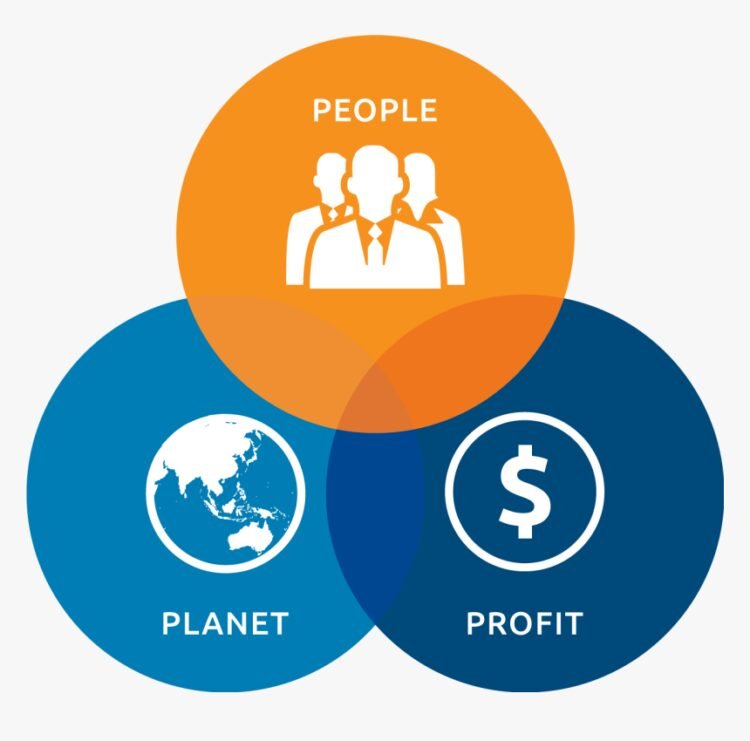
Every organization’s success depends on its ability to adopt decisions and execute essential procedures swiftly, effectively, and consistently, including introducing new strategies or projects. Implementation of new strategies, projects, or extending the definition and reaching of CSR is always associated with some risks and requires careful preparation and monitoring of the result. Key performance indicators (KPI) are the most suitable tool for assessing progress in achieving the specified Triple Bottom Line (TBL) objectives within corporate social responsibility (CSR). It would be best to start by asking a strategic question for each element of Triple Bottom Line (TBL). This is a powerful technique that helps both in developing a strategy and understanding the tools and criteria for monitoring its effectiveness. Strategic questions force one to think in a way that inspires movement and helps you find new approaches. It is imperative to implement TBL because many of the challenges that the Continue reading
Performance Management Tools
Advantages and Limitations of the Balanced Scorecard (BSC)
Before Balanced Scorecard (BSC) emerged, organizations usually use traditional methods of performance evaluation focused mainly on financial measures such as ROCE, sales and profits. Balanced Scorecard translates an organization’s mission and strategy into a comprehensive set of performance measures that provides the framework for a strategic measurement and management system. The scorecard measures organizational performance across four linked perspectives: financial, customer, internal business process, and learning and growth. In recent years, a number of multi-national organizations have introduced BSC as part of their management control systems. Advantages of the Balanced Scorecard Balanced Scorecard has been widely used in many organizations in the past 15 years. It obviously has some benefits to these organizations. Here are some of the advantages of Balanced Scorecard and they are also reasons that make so many organizations adopt BSC. Firstly, each perspective of Balanced Scorecard requires the identification of a number of goals, and suitable Continue reading
HR Scorecard: A Balanced Scorecard for HR

The new economic paradigm is characterized by speed, innovation, quality and customer satisfaction. The essence of the competitive advantage has shifted from tangible assets to intangible ones. The focus is now on human capital and its effective alignment with the overall strategy of organizations. This is a new age for Human Resources. The entire system of measuring HR‘s contribution to the organization‘s success as well as the architecture of the HR system needs to change to reflect the demands of succeeding in the new economy. The HR scorecard is a measurement as well as an evaluation system for redefining the role of HR as a strategic partner. Managers often use an HR Scorecard to measure the HR function’s effectiveness and efficiency in producing employee behaviors and thus in achieving the company’s strategic goals. The HR Scorecard is a concise measurement system. It shows the quantitative standards or “metrics” the firm Continue reading
Key Performance Indicators (KPIs) – Meaning and Types

Key Performance Indicators are a type of performance measurement tool. It allows management to measure the performance of a company in a certain area such as profitability. KPIs can help a team to work together to achieve a common set of measurable goals, and provide a very quick way of seeing the actual performance of a goal or strategic objective. Key Performance Indicators are mostly use to monitor an operation or to measure focusing in the aspects of organizational performance which are most critical for an organization current and future success. Key Performance Indicators (KPIs) are used in order to assess the company’s performance in their business units, division, departments and employees. It is very helpful in providing evidence that certain results have or have not been achieved, enable achievement of intended outputs, outcomes, goals and objectives to be mad by decision makers, help in perceiving differences, improvements or developments Continue reading
Alignment – A Strategic Management Concept By Kaplan & Norton

Alignment is a key factor in effective implementation of strategy. Most large organizations are divided into business units which are out of sync and work at cross purposes. The challenge is to coordinate the activities of these units and leverage their skills for the benefit of the organization as a whole. Kaplan & Norton call this alignment on their book “Alignment: Using the Balanced Scorecard to Create Corporate Synergies.” “Most organizations attempt to create synergy, but in a fragmented, uncoordinated way,” Robert S. Kaplan and David P. Norton. By aligning the activities of its various business and support units, an organization can create additional sources of value in various ways. Financial synergies can be generated through centralized resource allocation and financial management. Value can also be created if corporate headquarters can operate internal capital markets better than external market mechanisms and share knowledge across business units, in a manner that Continue reading
Balanced Scorecard (BSC) – A Strategic Management Tool

In the late 1980s, organisations started realizing that, in order to assess the overall health and performance of the organisation, it was important to measure and manage non-financial measures also in addition to the traditional financial measures such as profits, share values, sales volumes etc. Traditional financial measures are usually the lag indicators of the business performance and tell the story of the past. They do not provide any insight into the intangible assets and capabilities that need to be developed in order to be able to achieve the desired financial results. For example, front-line workers in a manufacturing set up are far removed from these financial measures and have no idea about how their day to day work translates into financial results. Thus, financial measures fail in assessing the intangible value possessed by the organisation or the value it can create. They can also fail the knowledge based strategies Continue reading