The performance of corporation organizations is an essential piece of information for investors and stakeholders. Return on investment is one of the most applied tools to measure the performance of business organizations. It helps investors establish the profitability of a given investment regarding capital. Social return on investment (SROI) measures how an organization adds value to the environment and communities. The change is measured by evaluating the company’s social, economic, and environmental outcomes, which are also the pillars of sustainable development. Social return on investment is an ideal tool for measuring social impacts and should be employed in medium and large corporations.
To achieve true sustainability, organizations report on three main aspects: financial gains, as well as social and environmental impacts of their activities, processes, and products. Over the years, financial reporting has been the most dominant way of measuring the performance of corporate organizations. However, with the rising concern about social and environmental impacts, the global reporting initiative standards were developed to help organizations determine their sustainability. Although most organizations are determined to achieve true sustainability, their investment and commitment efforts do not tally their social and environmental impacts. The organizations are not designed to achieve sustainable development but rather to make profits for the investors. As mentioned earlier, the goal of Social Return on Investment (SROI) is to help organizations measure their impact on society and the environment.
Social Return on Investment (SROI) is an organization performance measurement framework designed to be used by all industries and domains. It is also designed to help corporate account for their actions to the communities that contribute to their operations. The framework measures the change resulting from company operations and affecting the well-being of its stakeholders. In a nutshell, the framework measures the impact of the corporate on the value they add to the communities financially, socially, and environment-wise.
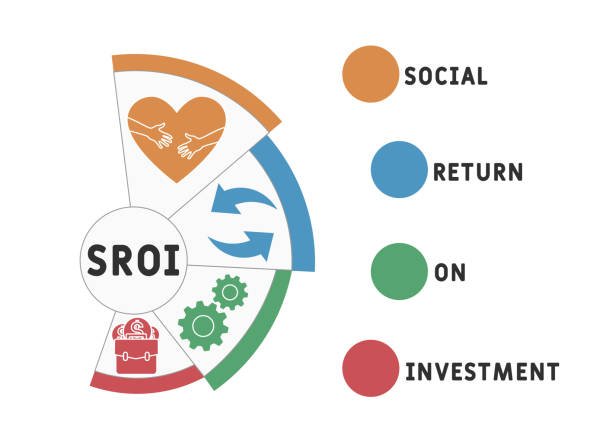
Social Return on Investment (SROI) is based on accounting principles that include involving stakeholders, transparency, and verifiable results. It also requires experts to understand the changes an organization undergoes and value only things that matter. Lastly, one should only include material things and not over-claim them.
The Social Return on Investment (SROI) analysis is carried out in six bold steps, each achieving a given role and paving the way for the next one. The first step identifies the organization or investment scope and the associated stakeholders. With the help of the stakeholders, the second step encompasses pairing inputs with outputs. This is achieved through an impact map, also known as the theory of change. The third stage supports the outcomes by associating them with relevant data. The next step establishes the impacts of the identified outcomes. In this step, outcomes that might have other causes are not considered in the following steps. The fifth step calculates the return on social investment. Here, organizations deduce the benefits of the investment, deduct the negative impacts, and juxtapose the results to the investment. In this step, the actual sensitivity of the results is calculated to provide a clear picture of the value of the investment. The last step involves sharing the findings of the report with stakeholders. The phase is often forgotten or downplayed by most managers, challenging the essence of the whole process. The organization incorporates the good results and engages in a constructive discussion with the shareholders on approaching the negatives identified.
The main goal of calculating social return on investment is to establish the performance value of a given investment to society and the environment. However, the results are only valuable when there are no other widely accepted frameworks. The SROI is not applicable in all situations. For example, SRIO is not useful in calculating the value of strategic plans developed and already in actualization. Unless stakeholders are interested in the results, it would be unnecessary to carry out the SROI calculations. Also, unless there is a need to implement changes to the way things are done, it would be useless to carry out SROI calculations in an organization. If the SROI analysis does not produce unintended results, it could result in unplanned stakeholder outrage, which could paralyze company operations. It could also result in unintended investments to correct defective systems and nonfunctional departments, hoping to make the organizations more accountable and sustainable.
Benefits of Social Return on Investment
Just like any other performance and value measurement framework, Social Return on Investment (SROI) presents its pros and cons, which are used to determine its usefulness in a given organization, context, or situation. Firstly, the framework provides evidence for the value of an investment in all domains: financial, social, and environmental. Usually, the impacts of an investment should not just be measured in terms of the financial gains, which is the case with most performance and value measurement frameworks. In cases where the financial value for a given activity or outcome is not known, the framework employs proxies that help in the value calculations. In the end, an organization can deduce the ideal value of an investment in a particular project in society and the environment.
With the help of other value establishment tools, such as results-based accounting, mapping, or program logic, the social return on investment can be used to measure the value of services provided. This implies the framework is applicable in seemingly impossible scenarios to establish the value of an investment on its financial, social, and environmental obligations. Unlike products, services are intangible and, at times, challenging to evaluate. The barrier is, however, overcome by the SROI performance and value measurement framework.
The Social Return on Investment (SROI) framework helps investors and managers engage in strategic discussions that help improve or maximize the value and quality of services offered. It also helps organizations identify essential resources, understand their applicability, and harness them to manage positive and negative risks. With the help of the SROI tools, organizations can establish and appreciate the importance of cooperating and working with other individuals or organizations that positively impact society and the environment. The tool helps organizations and stakeholders establish a common ground for the value addition of social and environmental affairs. The tool also enables stakeholders to take a proactive and constructive part in service formulation and actualization design, improving the organization’s reputation and value.
The SROI makes organizations more sustainable, raising their profile and reputation before customers, regulators, and investors. It also opens them up for further funding, which speeds up their growth and development. SROI improves the persuasiveness of companies bidding for public and private tenders. It makes a company more competitive, effective, accountable, and sustainable in its operations. As a result, the organizations are successful in their operations as they pay attention to value addition to society and not just financial gains.
Counter-Arguments Against Social Return on Investment
ROI calculates the social impacts of investments in various ways and whose difficulty varies depending on the associated activities. Although some activities are easily monetized, others are challenging as their functions are only comparable ordinarily. For example, some activities can only be evaluated using cost-of-use or revealed preferences. Some other social values can not be monetized, and experts find it challenging to substantial, which invalidates the entire framework.
Social Return on Investment (SROI) is a cumbersome framework to measure aspects that cannot be monetized, like an increase in saved lives or quality of life. Unlike financial analysis, experts do not agree on the kind of proxies that should be used where other reporting principles, frameworks, and standards have been well accepted. It implies that organizations have to develop their standards, which might not receive general acceptance or standardization, raising questions about the applicability of the SROI framework.
Social Return on Investment (SROI) is commonly applied in non-profit organizations such as schools, churches, heritage conservation instructions, and disaster relief organizations. Experts argue that it is challenging to establish commercial activities to be evaluated. As a result, the framework fails to achieve its targeted goal in such situations. On most occasions, it is impossible to measure the social outcome as the link between outcomes and the associated activities does not exist. Without a standard interval between activities and their corresponding outcomes, it becomes difficult for experts to settle on the resulting uncertainties, which invalidates the applicability of the model.