Case Study on Business Ethics: Avon Company Bribery Scandal in China

Avon incorporation is one of the leading door-to-door distributors of cosmetics. After a long period of successive trading in China, the internal audit of the subsidiary company indicated some form of misappropriation. This was attributed to management disregard to ethical management in financial decisions. The company, which engaged in direct sales of cosmetic products, exposed the malpractices of foreign officials. Although China prohibited the direct sale of products in the period prior to 2006, it allowed Avon to begin the direct sales on a limited basis. After February 2006, the act underwent amendment, which allowed for direct sales, but on strict regulations. As a result, it opened up the market for Avon. These subsequent events of the company lack of emphasis on ethical values led to the vulnerability of the company to employee malpractices. After the company realized the poor performance of its subsidiary in China, which was followed by Continue reading

Case Study: Corporate Social Responsibility of Starbucks

Starbucks is the world’s largest and most popular coffee company. Since the beginning, this premier cafe aimed to deliver the world’s finest fresh-roasted coffee. Today the company dominates the industry and has created a brand that is tantamount with loyalty, integrity and proven longevity. Starbucks is not just a name, but a culture. It is obvious that Starbucks and their CEO Howard Shultz are aware of the importance of corporate social responsibility. Every company has problems they can work on and improve in and so does Starbucks. As of recent, Starbucks has done a great job showing their employees how important they are to the company. Along with committing to every employee, they have gone to great lengths to improve the environment for everyone. Ethical and unethical behavior is always a hot topic for the media, and Starbucks has to be careful with the decisions they make and how they Continue reading

What Is International Franchising?

Franchisers sell a defined, proven business format or method of operation, offering a product or service that has sold successfully. An independent business is based on both an untried idea and operation. Franchisees can often buy lower-cost goods and supplies through the franchiser, resulting from the group purchasing power of all the franchises. Franchising provides a uniform system of operation, so that consumers receive uniform quality, efficiently and cost-effectively. A uniform system brings with it the advantages of mass purchasing power, brand identification, and customer loyalty, capitalizing on the proven format. A franchiser also provides management assistance, including accounting procedures, personnel and facility management. An individual with experience in these areas may not be familiar with how to apply them in a new business. The franchiser helps a franchisee overcome this lack of experience. Franchisors help franchisees develop a business plan. Many elements of the plan are standard operating procedures Continue reading

Case Study: American Express “Do More” Advertising Campaign

American Express had built its reputation as a prestigious charge card. In 1976 the company began its famed ‘‘Do You Know Me?’’ campaign in which celebrities ranging from dancer Mikhail Baryshnikov to puppeteer Jim Henson appeared in ads that pictured them and an AmEx Green Card bearing their names. In 1987 the ‘‘Portraits’’ campaign followed a similar formula. By aligning the brand with stars, AmEx cultivated the notion that carrying one of its cards was more akin to joining an elite country club than making a financial transaction. As later ads sniffed, ‘‘membership has its privileges.’’ In the 1980s, however, AmEx’s careful positioning began to backfire. According to Brandweek, while AmEx ‘‘clung to its old, elite ways,’’ the credit card industry went through monumental changes. With so many cards vying for consumers’ attention, Visa and MasterCard (specifically, the member banks that comprised the Visa and MasterCard consortia) began to cross-market Continue reading

Entrepreneurship Characteristics

The process of discovering new venture with creativity and innovation is called entrepreneurship. Entrepreneurship requires assumption of risk and reaping of awards. It brings resources together and provides option for self-employment to an individual. Entrepreneurship also creates employment opportunity for others. Entrepreneurship is a mind set of creativity and risk taking. It is a process of identifying opportunities and bringing together factors of production to exploit these opportunities. Entrepreneurship results in creation of new venture by planning, organizing, operating and assuming the risk. It always aims for innovation, profitability and growth. The entrepreneurial spirit has appeared as the engine of economic development. Entrepreneurship has resulted in millions of new ventures in the world. Entrepreneurship has appeared as the driving force for industrial and economic development. Therefore, the interest in the concept of entrepreneurship is growing in today’s world. Entrepreneurship has the following characteristics: Creating New Venture – Entrepreneurship is concerned Continue reading

Stage Gate Process by Robert Cooper Explained

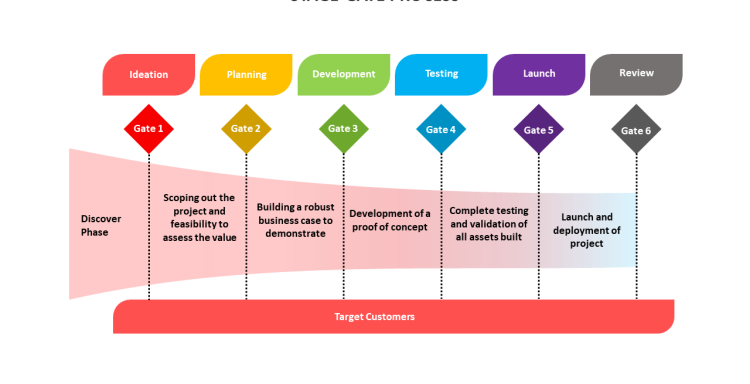
Entrepreneurs use a set of approaches and tools to assess the viability and potential of ideas and profit from them by developing and launching products. Cooper’s Stage Gate Process is one such approach that is key to any product or service in the commercial or non-commercial sector. Cooper’s Stage Gate Process is critical to the processes and performance of an organization as it reduces production errors and therefore saves the company from losses. Cooper’s Stage Gate Process is one of the most frequently used tools in the project development process. This model is based on the fact that any project is broken down into stages that make up a cascade, and to move from one stage to another, managers must go through the “gate”. These gates are critical points for deciding whether to proceed to the next stage. Simultaneously, decisions made at these gates have such options as “go”, “kill”, Continue reading