Role of Supply Side Policies in Balanced Economic Growth
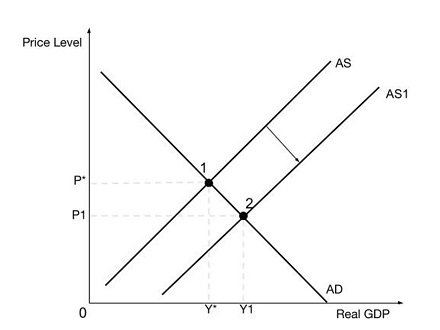
The government has a responsibility for delivering public goods optimally for the collective development of all individuals. In the quest to achieve this noble course, supply side policies, which form part of macroeconomic strategies, are developed to ensure that markets and industries function in an efficient way to increase the rate of economic growth as reflected in the real national yield.  Many governments support the assertion that they can achieve a sustained economic growth by improving supply side operations without causing an increase in inflation. However, reforms on the supply side policies do not facilitate the achievement of adequate growth. Definition and Explanation of Balanced Economic Growth Although the growth rate does not reflect people’s living standards entirely, economic growth has been one of the critical areas of consideration for every nation that is in the process of developing its economic policies. Indeed, economic growth is the most common approach Continue reading

System Development Life Cycle

To understand system development, we need to recognize that a candidate system has a life cycle, much like a living system or a new product. Systems analysis and design are based to the system life cycle. According to Dennis, Wixom, and Tegarden(2009) “the systems development life cycle (SDLC) is the process of understanding how an information system (IS) can support business needs by designing a system, building it, and delivering it to users.”  The stages are described below. The analyst must progress from one stage to another methodically, answering key questions and achieving results in each stage. Step 1: Recognition of Need — What is the Problem? One must know what the problem is before it can be solved. The basis for a candidate system is recognition of a need for improving an information system or a procedure. For example, a supervisor may want to investigate the system flow in Continue reading

An Introduction to Affiliate Marketing – Steps and Strategies

One of the easiest forms of online marketing is affiliate marketing. It is a marketing strategy where a merchant or a business house pays an affiliate for making a sale of their products and services. In short affiliate marketing means redirecting or referring a customer to a product or service that the affiliate marketer recommends with the intention of converting him into a client. The affiliate marketer is paid on the basis of the sales he or she generates for the company or the business house. The four main people involved in affiliate marketing are the seller/company/business house/brand, the affiliate or the network which promotes the product, the publisher and the customer. There are also secondary players involved in this game of affiliate marketing. They are the affiliate management agencies, the super affiliates and the specialized third party vendors or sellers. Affiliate marketing and internet marketing do overlap at times Continue reading

Five Domains of Emotional Intelligence

Several studies have demonstrated that individuals with purely high IQs possess a great range of intellectual interests and abilities, they have difficulty dealing with their own emotions and with the emotions of others. Other intangible characteristics and abilities, such as self-motivation, impulse control, the ability to regulate one’s own emotions, and empathizing with others clearly have an effect on a person’s accomplishments in life; these qualities have been collectively termed Emotional Intelligence. People with high emotional intelligence levels excel socially, are outgoing and cheerful, are rarely fearful or worried, and are sympathetic and caring in their relationships. Read More: Four Components of Emotional Intelligence Five Domains of Emotional Intelligence Emotional intelligence can be broken down into five main domains: knowing one’s emotions, managing emotions, motivating oneself, recognizing emotions in others, and handling relationships. 1. Knowing One’s Emotions – Self Awareness People deal with their emotions by either being aware of Continue reading

Leadership Characteristics – What Makes an Effective Leader

There are some specific characteristics that are found inside people who are born that seem like a developed skills and abilities which open themselves in a wise position where they look like a good leader. There are some characteristics that are found in a good leadership skill and these qualities can be a natural part of their personality and daily activities. First, confidence that must appear from a person like trustness and believing in their own abilities. And also can be said that someone empowers their working for them to make their own decisions. For example, make a decisions following on their own idea like creating something new and with some experience like a student doing their best in their final exam with a lot hopes and also the confidence comes from the parents and teacher who guides and approaches them at all the times. Second, a good character  plays Continue reading

Securities Contracts (Regulation) Rules, 1957

The Central Government has made Securities Contracts (Regulation) Rules, 1957, in the exercise of the powers conferred by section 30 of SC(R) Act., 1956 for carrying out the purposes of that Act. The powers under the SC(R)R, 1957 are exercisable by SEBI. Contracts between members of recognised stock exchange All contracts between the members of a recognised stock exchange shall be confirmed in writing and shall be enforced in accordance with the rules and bye-laws of the stock exchange of which they are members (Rule 9). Books of account and other documents to be maintained and preserved by every member of a recognised stock exchange : (1) Every member of a recognised stock exchange shall maintain and preserve the following books of account and documents for a period of five years: (a) Register of transactions (Sauda book). (b) Clients’ ledger. (c) General ledger. (d) Journals. (e) Cash book. (f) Bank Continue reading