Demand Curve under Different Market Structures

Firm Demand (company demand) denotes the demand for the product/s of a particular firm. While Industry demand means the demand for the product of a particular industry. An industry comprises all the firms or companies producing similar products which are quite close substitutes to each other irrespective of the differences in their brand names. To understand the relation between company and industry demand necessitates an understanding of different market structures. The demand curve of an individual firm is not the same as the industry or market demand curve except in case of monopoly. Monopoly is that market category in which there is only a single seller and therefore there is no difference between a firm and an industry. The firm is itself an industry and therefore the demand curve of the individual firm as well as the industry demand curve under monopoly will be the same and as we shall Continue reading
Three Concepts of Poverty – Economic wellbeing, Capability, and Social Exclusion

Poverty – A Multidimensional Phenomenon Poverty has many faces, and multiple indicators are used to capture the different deprivations experienced by a population. This complex phenomenon is linked to economic wellbeing, capability, and social exclusion. Poverty is a major moral problem because of the suffering it causes and the disadvantages conferred to some population segments. It is defined as a persistent and debilitating social condition attributed to diverse causes that affect a person’s physical, mental, and emotional wellbeing. The complex nature of poverty means that multiple measures are used depending on a country’s priorities. 1. Economic Wellbeing Income and consumption are key quantifiable indicators of poverty in society. These variables measure economic wellbeing and contain absolute, relative, and subjective components. At the basic level is absolute poverty, which describes the lack of necessities needed for survival – shelter, clean water, and food. Here, the quality of survival is an important Continue reading

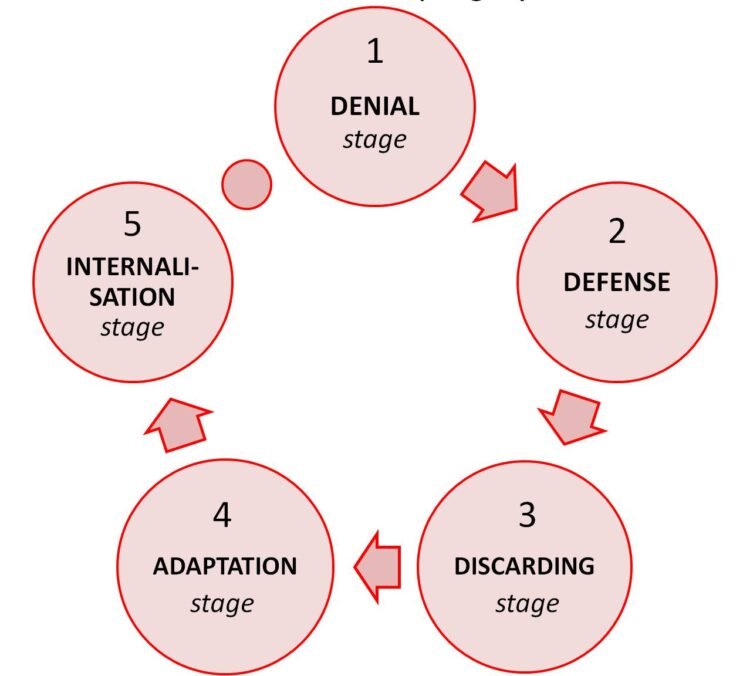
Colin Carnall’s Coping Cycle Model of Change Management

In the field of psychology, numerous models and theories have been developed to explain how individuals cope with various challenges and stressors in their lives. One such model is Colin Carnall’s Coping Cycle Model, which identifies five stages that individuals go through when faced with difficult situations. Carnall’s Coping Cycle Model consists of five stages — denial, defense, discarding, adaptation, and internalization — which are explained in detail, shedding light on their significance and implications. Denial – The first stage of Carnall’s Coping Cycle Model is denial. During this stage, individuals tend to resist or ignore the reality of a challenging situation. Denial acts as a protective mechanism, shielding individuals from the initial shock and emotional distress associated with the situation. However, it is important to note that denial is usually temporary and serves as a starting point for individuals to process the situation further. Defense – The second stage, Continue reading

Stakeholder Analysis – Mendelow’s Matrix

As stewards of the shareholder’s investment, directors have a fiduciary duty to safeguard their investment in the business and to work to maintain and increase the wealth of the shareholder. This is the traditional or stockholder view, but a more considerate approach states that companies should not have a limited view; rather they should have an extended view with regard to the whole society. The stakeholder view states that that as an organization is so powerful, socially, politically and economically, unrestrained and injudicious use of their power will eventually lead to the infringement of the rights of other people. The stakeholder theory thus proposes corporate accountability, not just to the shareholders, but to the stakeholders of the company as well. A stakeholder is an entity that can affect, or be affected by the achievement of an organization’s objectives. But, there is considerable dispute about who should be considered to be Continue reading

Foreign Direct Investment Incentives

Incentives are any measurable economic advantage afforded to specific  enterprises or categories of enterprises by (or at the direction of) a government,  in order to encourage them to behave in a certain manner. They include  measures either to increase the rate of return of a particular FDI undertaking, or  to reduce (or redistribute) its costs or risks. They do not include broader  nondiscriminatory policies, relating to the availability of physical and business  infrastructures, the general legal regime for FDI, the general regulatory and  fiscal regime for business operations, free repatriation of profits or the granting  of national treatment. While these policies certainly bear on the location  decisions of TNCs, they are not Foreign direct investment  incentives. The main types of Foreign direct investment  incentives used are fiscal incentives (e.g. reduction of the standard corporate  income-tax rate, investment and reinvestment allowances, tax holidays,  accelerated depreciation, exemptions from import duties), financial incentives Continue reading

The Role of Group Influence in Consumer Behavior

So is its true that individualism is dead and that consumer behavior is dominated by the influence of groups? There is no doubt consumer behavior is heavily influenced by groups. Individuals are always striving to conform to group behavior and to please others and this influences the purchase choices that they make. The influence of groups also helps to establish trends in lifestyle, fashion, and the assimilation of new products, into the lives of consumers. The notion of ‘virtual communities’ has been around ever since the inception of the internet. Whereas people used to meet and form communities geographically, the internet allows groups of like-minded people to meet virtually through communities based on, for example, online chat rooms and forums. Here individuals, who share common interests, can make contact with each other without any geographic restrictions. The interaction between members of such groups tends to be more uninhibited that it Continue reading