Non-Verbal Communication – Meaning and Types

Non-verbal communication or most commonly known as body language is the unspoken language of the body which is shown through our bodies to show our true intentions and hints of our feelings to the people whom we are conversing with. When we are conversing with others verbally our bodies simultaneously give out and receive signals which are transmitted by our bodies. This signal’s consists of the gestures we make, how we sit, the intonation and speed of how we talk, the distance we stand when talking and the amount of eye-contact we make while conversing. All this transmits vital non-verbal messages of oneself to another. These non-verbal messages still get across to the people around even when we are silent. The verbal message and body language very frequently contradicts which leaves the listener to choose which one to believe. Usually they will choose the body language. This is the reason Continue reading
Supply Side Policies – Meaning, Definition, and Categories

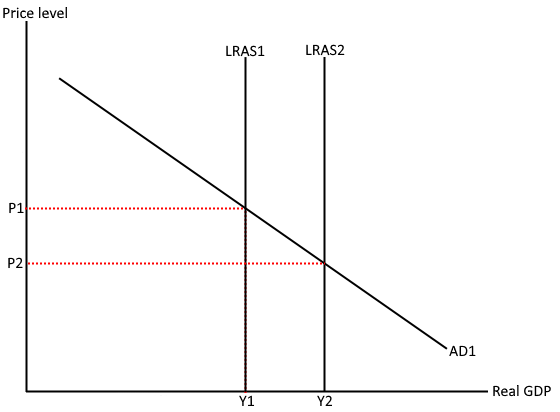
The supply side policies entail the attempts undertaken by governments in an effort to stimulate productivity and ensure that the long-term aggregate supply [LRAS] curve shifts to the right as illustrated in graph 1 below. The outward shift of the LRAS curve leads to an increase in the potential output. From the graph, the shift in the LRAS to LRAS2 leads to an increase in the size of the output from Y1 to Y2. The supply side policies are focused on stimulating a country’s productive capacity. Labor productivity is one of the most important elements in the supply side policies. The policies underscore the importance of establishing flexible labor markets. Despite the flexibility aspect, the role of the government in the implementation of the supply side policies cannot be ruled out. In some instances, government intervention is necessary in order to overcome market failure. The objective of the supply side Continue reading

Components of Supply Chain

A supply chain is a network of manufacturers, suppliers, distributors, transporters, storage facilities and retailers that perform functions like procurement and acquisition of material, processing and transformation of the material into intermediate and finished tangible goods, and finally, the physical distribution of the finished goods to intermediate or final customers. Major Components of Supply Chain A supply chain may consist of variety of components depending on the business model selected by a firm. A typical supply chain consists of the following components: Customers: The customer forms the focus of any supply chain. A customer activates the processes in a supply chain by placing an order with the retailer. The customer order is filled by the retailer, either form the existing inventories, or by placing a fresh order with the wholesaler/manufacturer. In some cases a customer bypasses all these supply chain components by getting in touch with the manufacturers directly. For Continue reading

International and Comparative Human Resource Management

International Human Resource Management has been defined as HRM issues, functions, policies and practices that result from the strategic activities of MNEs. International Human Resource Management deals principally with issues and problems associated with the globalization of capitalism. It involves the same elements as domestic HRM but is more complex to manage, in terms of the diversity of national contexts and types of workers. The emphasis is on the MNCs’ ability to attract, develop and deploy talented employees in a multinational setting and to get them to work effectively despite differences in culture, language and locations. International HRM tends to mitigate the impact of national culture and national employment practice against corporate culture and practices. Comparative Human Resource Management, on the other hand, is a systematic method of investigation that seeks to explain the patterns and variations encountered in cross-national HRM rather than simply describe HRM institutions and practices in Continue reading

Career Counselling in Organizations

Career counselling is a process whereby an employee is guided by a manager in performance-related behavior. The employee is unable to perform the job satisfactorily. His work behavior is inconsistent with the work environment and organizational culture. It is manifested in fighting, stealing, unexcused lateness and absence.  Career counselling involves guiding of employee by a manager to overcome performance problems. The problem is desire-created based on unwillingness. Career counselling involves the following steps: Identification of the performance problem – The reason for poor performance should be identified. Specific job behavior should be objectively documented in terms of date, time, and what happened. The manager should have good listening skills to uncover the reason for performance problem. The manager should focus on job performance problems only, not the employee as a person. He should treat the employee objectively, fairly and equitably.  Make sure the employee owns up the problem – The Continue reading

Memorandum of Association of a Company

The Memorandum of Association is the charter of the company, and provides the foundation on  which the structure of the company is built. It defines the scope of the company’s activities as well as its  relation with the outside world. Section 2(28)of the Companies Act defines a Memorandum as “the memorandum of association  of a company as originally framed or as altered from time to time in pursuance of any previous Company  Laws or of this Act”. Section 13 of the Act specifies the contents of the memorandum. The importance of the Memorandum is that it lays down the ambit of the powers of the company,  the area within which the company can operate and beyond which it cannot go.  The purpose of the Memorandum is to enable the shareholders, creditors and those who deal with  the company to know what is its permitted range of enterprise. The Memorandum of Continue reading