Activity Based Costing (ABC) – Advantages and Disadvantages

In the past, the vast majority of departments used direct labor hours as the only cost driver for applying costs to products. But direct labor hours is not a very good measure of the cause of costs in modern, highly automated departments. Labor-related costs in an automated system may be only 5 percent to 10 percent of the total manufacturing costs and often are not related to the causes of most manufacturing overhead costs. Therefore, many companies are beginning to use machine-hours as their cost-allocation base. However, some managers in modern manufacturing firms and automated service companies believe it is inappropriate to allocate all costs based on measures of volume. Using direct labor hours or cost-or even machine hours-as the only cost driver seldom meets the cause/effect criterion desired in cost allocation. If many costs are caused by non volume-based cost drivers, Activity Based Costing (ABC) should be considered Activity Continue reading
Stock Beta – Meaning, Calculation, Applications and Types

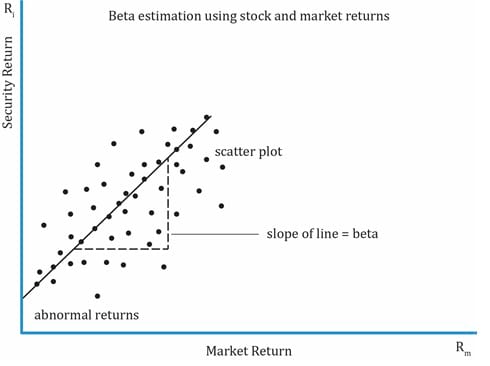
In finance, the Beta (β) of a stock or portfolio is a number describing the correlated volatility of an asset in relation to the volatility of the benchmark that said asset is being compared to. This benchmark is generally the overall financial market and is often estimated via the use of representative indices, such as the S&P 500, Nifty, Sensex, etc. Beta is also referred to as financial elasticity or correlated relative volatility, and can be referred to as a measure of the sensitivity of the asset’s returns to market returns, its non-diversifiable risk, its systematic risk, or market risk. On an individual asset level, measuring beta can give clues to volatility and liquidity in the marketplace. In fund management, measuring beta is thought to separate a manager’s skill from his or her willingness to take risk. The beta coefficient was born out of linear regression analysis. It is linked to a regression analysis of the returns of a portfolio (such as a stock index) (x-axis) in a specific period versus the returns Continue reading

Fixed-Rate Currency Swaps and Currency Coupon Swaps

Fixed-Rate Currency Swaps A fixed rate currency swap consists of the exchange between two counter-parties of fixed rate interest in one currency in return for fixed rate interest in another currency. Following are the main steps to all currency swaps: Initial Exchange for the Principal: The counter-parties exchange the principal amounts on the commencement of the swap at an agreed rate of exchange. Although this rate is usually based on the spot exchange rate, a forward rate set in advance of the swap commencement date can also be used. This initial exchange may be on a notional basis of alternatively a physical exchange. The sole importance of the initial exchange on being either on physical or notional basis, is to establish the quantum of the respective principal amounts for the purpose of (i) calculating he ongoing payments of interest and (ii) the re-exchange of principal amounts under the swap. Ongoing Continue reading

Conversion/Installation Modes of Information Systems

Conversion is the process of changing from the old system to the new one. It must be properly planned and executed. Four methods are common in use. They are: parallel systems, direct conversion, pilot system and systems phase-in. Each method should be considered in the light of the opportunities that it offers and problems that it may create. However, it may be possible that sometimes, we may be forced to apply one method over others, even though other methods may be more beneficial. In general, systems conversion should be accomplished in shortest possible time. Long conversion periods create problems for all persons involved including both analysts and users. Parallel Systems The most secure method of converting from an old to new system is to run both systems in parallel. Under this approach, users continue to operate the old system in the usual manner but they also start using the new Continue reading

Customer Relationship Management (CRM) – Definition, Benefits and Challenges

Customer Relationship Management (CRM) as the name suggests, the primary focal point is placed on the customer. The key objective is to increase customer value over time by increasing customer loyalty. If a company develops better customer relationships, it also improves business processes as well as its profits. In general, CRM is a more efficient automated method used to connect and improve all areas of business to focus on creating strong customer relationships. All forces are coupled together to save, improve, and acquire greater business to customer relationships. The most common areas of business that are positively affected include marketing, sales, and customer service strategies. Customer Relationship Management (CRM)  helps create time efficiency and savings on both sides of the business spectrum. Through correct implementation and use of CRM solutions, companies gain a better understanding of their strongest and weakest areas and how they can improve upon these. Therefore, customers Continue reading

Post-Shipment Finance

Post shipment finance is provided to meet working capital requirements after the actual shipment of goods. It bridges the financial gap between the date of shipment and actual receipt of payment from overseas buyer thereof. Whereas the finance provided after shipment of goods is called post-shipment finance. DEFINITION: Credit facility extended to an exporter from the date of shipment of goods till the realization of the export proceeds is called Post-shipment Credit. IMPORTANCE OF FINANCE AT POST-SHIPMENT STAGE: To pay to agents/distributors and others for their services. To pay for publicity and advertising in the over seas markets. To pay for port authorities, customs and shipping agents charges. To pay towards export duty or tax, if any. To pay towards ECGC premium. To pay for freight and other shipping expenses. To pay towards marine insurance premium, under CIF contracts. To meet expenses in respect of after sale service. To pay Continue reading