The Diamond-Water Paradox in Economics
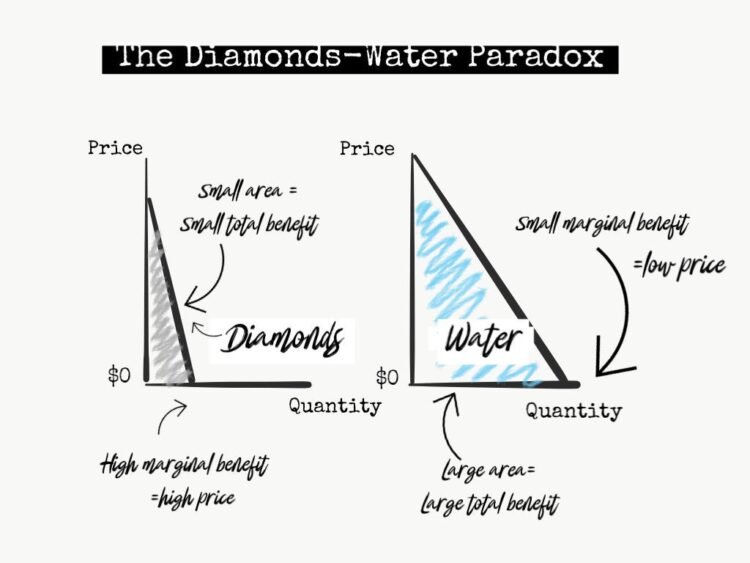
The concept of the value of goods was one of the most actively discussed topics by economists in the 18-19th century. In “A Study of the Nature and Causes of the Wealth of Nations,” published in 1776, Adam Smith voiced the question that would later become known as the diamond-water paradox. It sounded like this: “There is nothing more useful than water: but you can hardly buy anything with it… Diamond, on the contrary, has almost no use-value; but a very large number of other goods can often be obtained in exchange for it”. The classical economists Adam Smith and Karl Marx considered a product’s value concerning how it satisfies a human need. The price was associated with the effort and labor expended to meet a specific demand. Besides, classical economists used the concepts of use-value and exchange-value, which determine the nature and exchange value of products. Later, in the Continue reading

