Risk Matrix Approach to Risk Analysis
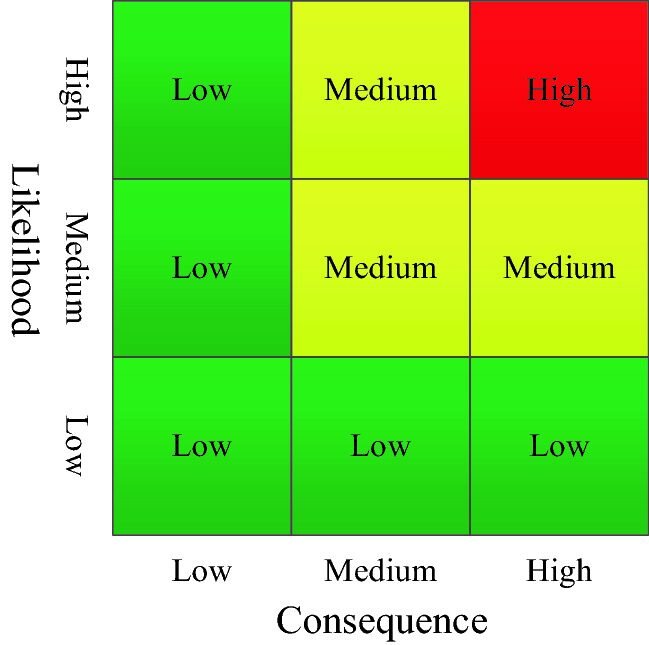
A risk matrix is defined as a table that is divided into several categories of probability, likelihood, or frequency for its rows, and multiple categories of severity, impact, or consequences for its columns. The constituents of risk ordinarily attest themselves as a hazard; which refers to the likely origin of a harmful outcome and harms; which are the ensuing damages to the environment. It incorporates generally accepted ratings of risk, urgency and priority, with every row-column pair. This is represented by distinct cells which are separately colored, using red, green and yellow colors. Each distinct cell has a different risk rating, for instance, cells colored in red will indicate risks that require an urgent attention, whereas those that are colored in green will indicate those risks that do not require to be dealt with urgently. The yellow colored cells indicate those risks that fall in between the ratings of very urgent and Continue reading

Benefits and Drawbacks of Scientific Management Theory

Management has changed from traditional methods to more modern forms of leadership. The change has been brought by the need to change and to try to make the organizations work better. Different approaches to organizational design can affect the company’s work differently, so the management style should be chosen individually for each case, depending on the organization’s goals. One of the options is scientific management, based on applying scientific theories and principles to design work in organizations. Since the early 20th century, scientific management has been at the forefront of organizational design. The design development was spearheaded by Frederick W. Taylor, who aimed to boost workplace productivity using scientific techniques. Scientific management has substantially influenced work design in contemporary companies, with its virtues and flaws under everyday discussion. The prediction of scientific management is based on the notion that efficiency in the workplace may be increased via scientific methodologies and Continue reading

Understanding ROI in Higher Education: How Students Evaluate the Value of an MBA or BBA Degree

In today’s competitive job market, pursuing higher education, especially business degrees like an MBA or BBA, is seen as both a professional investment and a complicated financial decision. As tuition costs rise globally, students are increasingly assessing their educational choices through the lens of return on investment (ROI). Evaluating ROI in higher education helps prospective learners understand whether the time, money, and effort they invest will generate meaningful personal and professional returns in the long term. Here’s what you need to know:  The Concept of ROI in Education In traditional business terms, ROI measures the profitability of an investment relative to its cost. Applied to education, ROI reflects the difference between what students spend on a degree and what they gain from it, monetarily and non-monetarily.  Financially, it can be measured through salary increases, job promotions, or employability prospects after graduation. Intangible benefits include personal growth, enhanced critical thinking, leadership Continue reading

The Ethics of Sweatshops in Fashion Industry

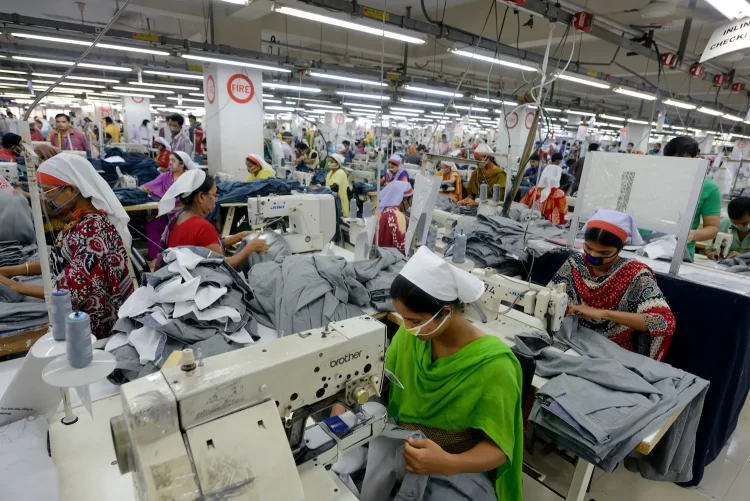
Although the fundamentals of sweat labours have changed since the 18th Century, it still has many similarities between the history and the present. In fashion industry, as the market desire and has developed into new forms, resulting in the use of sweat labours to continue. Sweatshop is a general description of the workplaces which paying poor salary, unsafe or unhealthful working environment, force to a longer working period or using child labour. The term sweatshop is not a new phenomenon but in fact a derivation from history. In 1997, Nike as one of the world largest sport garment company, was caught in a scandal of using sweatshop labour for its garment production in East South Asia. Paying unreasonable salaries, forcing labourers to overwork. As a result, for many years, this has become a label that has tagged on Nike’s logo. Such a worldwide company was soon to be boycotted by its Continue reading

What is a Collaborative Robot (Cobot)?

“Machines alone do not give us mass production. Mass production is achieved by machines and men.” – Henry Ford II ,1914 Above quote which said by Henry Ford, it doesn’t mean that human alone cannot achieve mass productions but with machines, mass productions can be easily achieved with the right machines. Computer-controlled, intelligent assist devices are a huge change in material handling technology today. The step changes in their ergonomics, productivity, quality and safety capabilies – especially when compared with tradition pneumatic tools which are considered old schooled in compared with cobots today. Cobots, or collaborative robots, are robots intended to interact with humans in a shared space or to work safely in close proximity. Cobots stand in contrast to traditional industrial robots which are designed to work autonomously with safety assured by isolation from human contact. Cobot safety may rely on lightweight construction materials, rounded edges, and limits on speed Continue reading

The Chinese Room Argument by John Searle

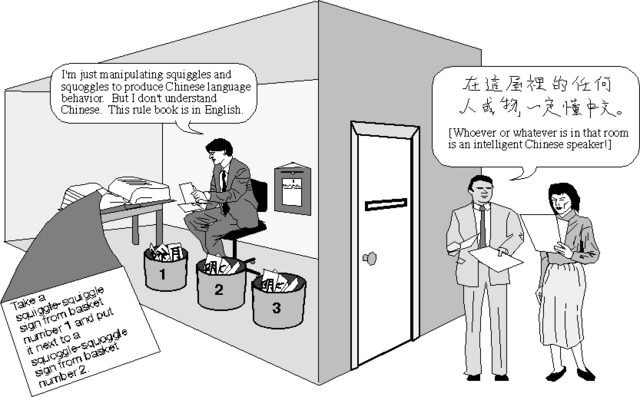
John Searle’s famous Chinese Room Argument has been the target of great interest and debate in the philosophy of mind, artificial intelligence and cognitive science since its introduction in Searle’s 1980 article ‘Minds, Brains and Programs’. It is no overstatement to assert that the article has been the centre of attention for philosophers and computer scientists for quite some time. The Chinese Room is supposed to scuttle the thought of strong AI: which implies that computers have mental states. The Chinese Room arises out of the following, now familiar, story: Searle asks us to imagine that a man is seated in a sealed room with 2 doors: one allowing input from one source outside the room (in the form of a slot) and one allowing output to the source outside the room (also in the form of a slot). The input from the outside source are Chinese squiggles that have Continue reading