
The term circular economy (CE) has both a linguistic and descriptive meaning. Linguistically it is an antonym of a linear economy. A linear economy is one defined as converting natural resources into waste, via production. Such production of waste leads to the deterioration of the environment in two ways: by the removal of natural capital from the environment (through mining/unsustainable harvesting) and by the reduction of the value of natural capital caused by pollution from waste. And the word circular has a second, inferred, descriptive meaning, which relates to the concept of the cycle. There are two cycles of particular importance here: the biogeochemical cycles and the idea of recycling of products. By circular, an economy is envisaged as having no net effect on the environment; rather it restores any damage done in resource acquisition while ensuring little waste is generated throughout the production process and in the life history Continue reading
Economics Principles
Economic Systems – Planned Economy, Free Market Economy and Mixed Economy
System of Planned Economy Under the conditions of the planned economy, all decisions concerning what to manufacture, how to manufacture and to whom to manufacture are approved by the sole center or group. This economy is based on collective ownership. Fixed production assets are owned by the government, and resources, production and the quantities of future products are distributed according to a plan. The type of the system of the command economy was prevailing in the USSR, Cuba, and North Korea. The plans of the system of the centralized economy are drawn up and implemented by the authorities and governmental political leaders after consulting with highly ranked professionals: engineers, economists, industrialists, and other experts. These planners decide which products to manufacture and which services to render. Their vote is decisive in approving decisions whether new undertakings are to be constructed, how many employees are to be employed at undertakings, whether Continue reading
Laws of Returns in Economics

The relationship between the inputs and the output in the process of production is clearly explained by the Laws of Returns or the Law of Variable Proportions. This law examines the production function with only one factor variable, keeping the quantities of other factors constant. The laws of returns comprise of three phases: The Law of Increasing Returns. The Law of Constant Returns. The Law of Diminishing Returns. The Laws of Returns in Economics may be stated as follows: “If in any process of production, the factors of production are so combined that if the varying quantity of one factor is combined with the fixed quantity of other factor (or factors), then there will be three tendencies about the additional output or marginal returns: Firstly, in the beginning, as more and more units of a variable factor are added to the units of a fixed factor, the additional Continue reading
Role of Supply Side Policies in Balanced Economic Growth
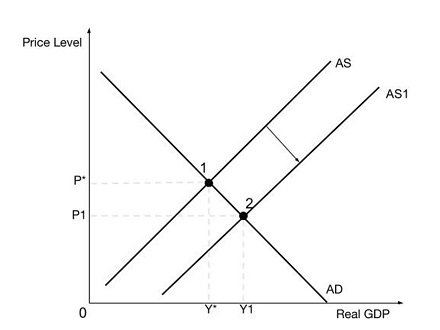
The government has a responsibility for delivering public goods optimally for the collective development of all individuals. In the quest to achieve this noble course, supply side policies, which form part of macroeconomic strategies, are developed to ensure that markets and industries function in an efficient way to increase the rate of economic growth as reflected in the real national yield. Many governments support the assertion that they can achieve a sustained economic growth by improving supply side operations without causing an increase in inflation. However, reforms on the supply side policies do not facilitate the achievement of adequate growth. Definition and Explanation of Balanced Economic Growth Although the growth rate does not reflect people’s living standards entirely, economic growth has been one of the critical areas of consideration for every nation that is in the process of developing its economic policies. Indeed, economic growth is the most common approach Continue reading
Economic Tools for Management Decision Making

Managerial decision-making draws on economic concepts as well as tools and techniques of analysis provided by decision sciences. The major categories of these tools and techniques are optimization, statistical estimation and forecasting. Most of these methodologies are technical. These methods are briefly explained below to illustrate how tools of decision sciences are used in managerial decision making. 1. Optimization Optimization techniques are probably the most crucial to managerial decision making. Given that alternative courses of action are available, the manager attempts to produce the most optimal decision, consistent with stated managerial objectives. Thus, an optimization problem can be stated as maximizing an objective (called the objective function by mathematicians) subject to specified constraints. In determining the output level consistent with the maximum profit, the firm maximizes profits, constrained by cost and capacity considerations. While a manager does not resolve the optimization problem, he or she may make use of the Continue reading
Dornbusch Exchange Rate Overshooting Model
The Dornbusch overshooting model, developed by Rudiger Dornbusch in 1976, is a theoretical framework used to explain the dynamics of exchange rates. It suggests that when there is a change in monetary policy or other economic factors, exchange rates overshoot their long-run capital flows before settling back to their equilibrium levels. The model helps explain the short-term volatility of exchange rates, which can have significant implications for international trade, investment, and capital flows. Assumptions of the Model: The Dornbusch overshooting model is based on several key assumptions. First, it assumes that prices and wages are sticky in the short run, meaning that they do not adjust immediately to changes in economic conditions. This is because many contracts, such as labor contracts and long-term supply contracts, are negotiated in advance and do not reflect current market conditions. As a result, changes in the money supply or other economic factors can lead Continue reading