Banks have all along played the role of financial intermediaries by channelizing funds primarily from the household sector to producing sector and the efficiency and smoothness with which such intermediation is done by banks are one of the prime parameters that determine the economic efficiency and consequent industrial and material progress of a society. Financial intermediation has a cost and that cost is reflected in bank rates and overhead expenditures incurred by banks. Bank rates, however, are not determined in isolation or only from the perspective of profit maximization by the banking sector. These rates are impacted by many other economic and statutory issues pertaining to a particular economy and such issues may vary widely from economy to economy depending upon the administrative attitude towards matters of equanimity in various sectors of the economy, especially the banking sector itself. The general view among experts in this field is that if Continue reading
Economics Principles
Baumol’s Sales Revenue Maximization Model
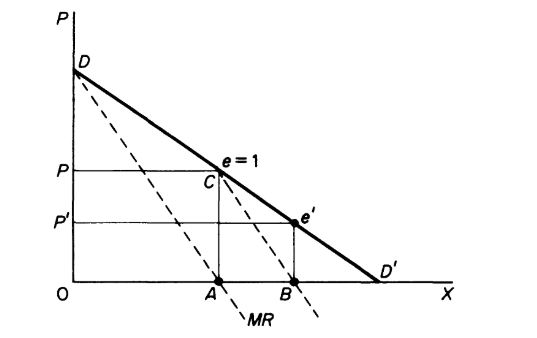
Sales maximization model is an alternative model for profit maximization. This model is developed by Prof. Boumol, an American economist. This alternative goal has assumed greater significance in the context of the growth of Oligopolistic firms. Baumol’s sales revenue maximization model highlights that the primary objective of a firm is to maximize its sales rather than profit maximization. It states that the goal of the firm is maximization of sales revenue subject to a minimum profit constraint. The minimum profit constraint is determined by the expectations of the share holders. This is because no company can displease the share holders. “Though businessmen are interested in the scale of their operations partly because they see some connection between scale and profits, I think management’s concern with the level of sales goes considerably further. In my dealings with them I have been struck with the importance the oligopolistic enterprises attach to the Continue reading
National Income Statistics: Meaning and Uses
What is National Income Statistics? According to most dictionaries, national income is literally the total amount of money earned by a certain country. But in order to calculate the total funds and asset of the country, National Income Statistics are used, which are basically a set of rules, techniques and calculation to measure the total value of final goods and services produced. However, The National Income Statistics are only valid to calculate the national income of a country in a year. The Uses of National Income Statistics Like every other calculations, The National Income Statistics also have their own uses. The National Income Statistics are very important to the development of a certain country as it is the result of hard works done in a year to contribute in the enhancement of a certain country. Firstly, as we all know money and riches usually determines the standard of living of Continue reading
Special Pricing Approaches Used in Business
A variety of approaches are employed by businessmen in setting prices. These approaches are not mutually exclusive but sometimes they complement or supplement one another. Some of them are: Intuitive Pricing: It is a psychological method of pricing in which prices are based on the ‘feel of the market’. The system is more subjective rather than objective in nature. Initially the price is estimated on the basis of cost plus method with flexible mark-up pricing. This method is fairly common. Experimental Pricing: It is a trial and error method of pricing. This method is widely used in pricing of new products especially at retail level. Initiative Pricing: In this method a firm decides to follow a price fixing policy of a price leader. Backward Cost Pricing: Certain industries target price as the starting point for strategic calculations. The selling price is determined first and by working backwards the firm arrives Continue reading
Cournot’s Duopoly Model – Explanation with Example
In economics, organizations that operate in oligopolies markets compete by trying to steal market shares from one another. Therefore, instead of competing by lowering prices, the kinked demand curve points to an understanding that the strategy does not work since every organization reduces costs. Companies utilizing this strategy often compete using a factor directly affecting profit and hence the quantity being sold. The Cournot’s model finds application when organizations produce standardized or identical products and, thus, do not collude. Duopolies, on the other hand, operate by the understanding that companies compete by the produced quantity. The assumption by the Cournot’s duopoly model is that two organizations move simultaneously, having similar market demand perspectives and having good knowledge of the cost functions of each rival. With this, firms choose how to maximize profit through their output based on the belief that rival organizations make similar choices. For the U.S., the decision Continue reading
Deficit Spending- Meaning, Advantages and Disadvantages

Deficit spending is the amount the government consumes that overtakes revenue over a particular budget year. Globally, it is a system used by most governments for economic stability. Deficit spending can be of either positive or negative impacts depending on the country’s aim in applying it. If well-strategized, it can be of immense aid to rescue the economic growth; it benefits every person in that specific government by opening room for investors. Deficit spending takes place when the government consumes more than the revenues. The government uses deficit spending for economic growth by opening opportunities for private sectors. For example, the private sector can offer loans to people so that they can start their businesses. In deficit spending, the consumption rate is higher than the profit that the government acquires. Therefore, the government spends more than what is available in addition to having more needs. Deficit spending multiplies huge debts Continue reading