Introduction to Marketing Research

Marketing research is the intelligence service of a business enterprise. American Marketing Association defined marketing research as “the gathering, recording and analyzing of all data about problems relating to the transfer and sale of goods and services from producer to consumer.” Objectives of Marketing Research To know the demographics and psychographics of customers:- Marketing research tries to reveal the number of persons who buy, why they buy, when they buy, the frequency of their buying, and the sources of their buying.   It also includes the social status and the regional location of the customers. To find out the impact of promotional efforts. To know customer response to a new product. To prove ‘what went wrong’. Nature of Marketing Research Marketing research is systematic and objective collection of data, its analysis and evaluation, and decision making in respect of specific aspects of a marketing problem. Marketing Research and Market Research:- Continue reading
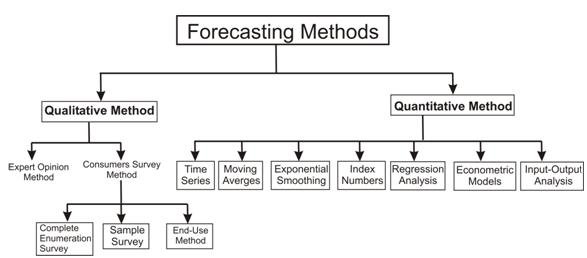
Expert Opinion Method of Demand Forecasting

In this method of demand forecasting, the firm makes an effort to obtain the opinion of experts who have long standing experience in the field of enquiry related to the product under consideration. If the forecast is based on the opinion of several experts then the approach is called forecasting through the use of panel consensus. Although the panel consensus method usually results in forecasts that embody the collective wisdom of consulted experts, it may be at times unfavorably affected by the force of personality of one or few key individuals. To counter this disadvantage of panel consensus, another approach is developed called the Delphi method. In this method a panel of experts is individually presented a series of questions pertaining to the forecasting problem. Responses acquired from the experts are analyzed by an independent party that will provide the feedback to the panel members. Based on the responses of Continue reading

Risk and Return in Portfolio Investments

Risk in Portfolio Investments The Webster’s New Collegiate Dictionary definition of risk includes the following meanings: “……. Possibility of loss or injury ….. the degree or probability of such loss”. This conforms to the connotations put on the term by most investors. Professional often speaks of “downside risk” and “upside potential”. The idea is straightforward enough: Risk has to do with bad outcomes, potential with good ones. In considering economic and political factors, investors commonly identify five kinds of hazards to which their investments are exposed. The following are different  components of risks associated with portfolio investments: A. Systematic Risk Systematic risk refers to the portion of total variability in return caused by factors affecting the prices of all securities. Economic, Political and Sociological changes are sources of systematic risk. Their effect is to cause prices of nearly all individual common stocks or security to move together in the same Continue reading

Market Activated Corporate Strategy (MACS) Framework

Market Activated Corporate Strategy (MACS) Framework was developed in the late 1980s. But it wasn’t developed at once. There were several predecessors to this framework. Once of the first can be the BCG Growth-Share Matrix. This matrix represents the market growth rate and the relative market share, and according to the level, the business units were divided into 4 categories. It was used very often before, but over the time more comprehensive tools were designed, to eliminate the weaknesses of BCG Matrix, like the fact that is takes into consideration only two factors, avoiding many many others that have a huge impact on profitability. BCG Matrix also assumes the independence of each business unit, therefore it leads to underestimation of the interconnection that often exists (as “Dogs”, for example, sometimes help in gaining competitive advantage) Another predecessor is the old nine-box matrix, developed by McKinsey. It covers industry attractiveness and Continue reading

Pre-shipment Finance

Pre-shipment is also referred as “packing credit”. It is working capital finance provided by commercial banks to the exporter prior to shipment of goods. The finance required to meet various expenses before shipment of goods is called pre-shipment finance or packing credit. DEFINITION: Financial assistance extended to the exporter from the date of receipt of the export order till the date of shipment is known as pre-shipment credit. Such finance is extended to an exporter for the purpose of procuring raw materials, processing, packing, transporting, warehousing of goods meant for exports. IMPORTANCE OF FINANCE AT PRE-SHIPMENT STAGE: To purchase raw material, and other inputs to manufacture goods. To assemble the goods in the case of merchant exporters. To store the goods in suitable warehouses till the goods are shipped. To pay for packing, marking and labelling of goods. To pay for pre-shipment inspection charges. To import or purchase from the Continue reading

The Pros and Cons of Securitization

Securitization forces banks to compete with institutional investors and other financial institutions for the business of prime borrowers. In response, banks are beginning to provide borrowers with a range of fee-earning services that facilitate the sale of debt instruments to investors. For example, banks offer borrowers note-issuing or underwriting facilities instead of loans and agree to help borrowers sell their debt instruments to investors as and when needed. Banks may also agree to purchase only the unsold portion of the debt issue. Thus, securitization is moving banks away from performing traditional banking functions, such as extending credit in exchange for periodic interest payments. In addition, securitization provides the creditor with two significant benefits. Because the lender can choose whether to trade the notes or to hold them to maturity, the lender can better manage its credit limits and asset portfolio. The bank also earns a major part of its income Continue reading