Overview of Reverse Innovation Concept

Vijay Govindarajan and Chris Trimble, in their book on Reverse Innovation defined the term “Reverse Innovation”; they define it as any idea, which will be first adopted in developing world. This phenomenon was not very common in the past for a simple reason that the rich and affluent that had the ability to demand were mostly concentrated in developed nations. Demand drove the technology and hence most of innovations happened in the west. United States and Germany have about 300 noble laureates in science and technology, while India and China who are six times in population have less than ten of them in total. Most of the solutions that were innovated in the west were hence imported. Slightly modified versions of the global products, mostly their low-end were “Glocalized” and were seem to be most relevant. This view, over time, is seemed to be no longer accurate. The nature of Continue reading

Human Resource Cost Reduction

Cost reduction is defined as the achievement of real and permanent reduction in the unit cost of goods manufactured or services rendered without impairing their suitability for use intended. Cost reduction must be real and increase productivity. It must be permanent and should not impair the suitability of products or services for the intended use. The scope of cost reduction is wide and it could be applied to wherever cost is incurred. In many organizations the cost of human resources is very high. The top management should find ways by which the cost of human resources is reasonably reduced. Any abnormal reduction of cost in this regard may lead to unfavorable organizational climate. In autocratic type of organizational climate the human resources cost will be reduced since the employer is not so particular about keeping the morale of the employees high and to motivate them for higher productivity. Since better Continue reading

Impact of Motivation on Employee Behavior and Performance

One of the most challenging aspects of human resource management is employee motivation. It manifests itself through employee morale, output, absenteeism, effort, labor turnover, loyalty and achievement. Motivation is generally defined as an internal state that induces an employee to engage in particular behaviors, or a set of factors that cause employees to behave in certain ways, but it is extremely complex. This is because employee motivation is the product of many interacting factors such as the culture of the organization, management’s leadership style, the structure of the organization, job design and HR policies and practices. The employee’s personality, skills, knowledge, abilities and attitudes also play a part. Motivation is not understood by managers and its essence remains enigmatic. It is what makes the “high fliers” fly. It is why some employees demonstrate a burning desire to achieve, and accept increased responsibility, while others remain passive or openly hostile. What Continue reading

Non-Verbal Communication – Meaning and Types

Non-verbal communication or most commonly known as body language is the unspoken language of the body which is shown through our bodies to show our true intentions and hints of our feelings to the people whom we are conversing with. When we are conversing with others verbally our bodies simultaneously give out and receive signals which are transmitted by our bodies. This signal’s consists of the gestures we make, how we sit, the intonation and speed of how we talk, the distance we stand when talking and the amount of eye-contact we make while conversing. All this transmits vital non-verbal messages of oneself to another. These non-verbal messages still get across to the people around even when we are silent. The verbal message and body language very frequently contradicts which leaves the listener to choose which one to believe. Usually they will choose the body language. This is the reason Continue reading

Supply Side Policies – Meaning, Definition, and Categories

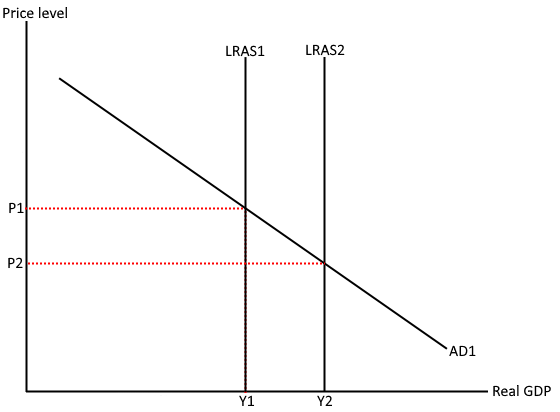
The supply side policies entail the attempts undertaken by governments in an effort to stimulate productivity and ensure that the long-term aggregate supply [LRAS] curve shifts to the right as illustrated in graph 1 below. The outward shift of the LRAS curve leads to an increase in the potential output. From the graph, the shift in the LRAS to LRAS2 leads to an increase in the size of the output from Y1 to Y2. The supply side policies are focused on stimulating a country’s productive capacity. Labor productivity is one of the most important elements in the supply side policies. The policies underscore the importance of establishing flexible labor markets. Despite the flexibility aspect, the role of the government in the implementation of the supply side policies cannot be ruled out. In some instances, government intervention is necessary in order to overcome market failure. The objective of the supply side Continue reading

Components of Supply Chain

A supply chain is a network of manufacturers, suppliers, distributors, transporters, storage facilities and retailers that perform functions like procurement and acquisition of material, processing and transformation of the material into intermediate and finished tangible goods, and finally, the physical distribution of the finished goods to intermediate or final customers. Major Components of Supply Chain A supply chain may consist of variety of components depending on the business model selected by a firm. A typical supply chain consists of the following components: Customers: The customer forms the focus of any supply chain. A customer activates the processes in a supply chain by placing an order with the retailer. The customer order is filled by the retailer, either form the existing inventories, or by placing a fresh order with the wholesaler/manufacturer. In some cases a customer bypasses all these supply chain components by getting in touch with the manufacturers directly. For Continue reading