Application of Nostalgia Concept in Marketing

The historical term of nostalgia, initially started as a medical term. The term was coined in 1688 by Johannes Hofer (1669–1752) in his Basel dissertation to refer on ‘homesickness’. Homesickness was one of the most serious sickness during that time. The term of “nostos” which means return and “algos” which means pain, were introduced to described people that suffering pain because of being far away from home and have needs to return to their home.  Subsequently, the term ‘nostalgia’ evolved, and moved away from being a disease. Nostalgia known as a term that refer to time: past, present and future. In order to be classified as nostalgia, there are four factors that need to be fulfilled: An emotional feeling of being lost in space and time. An emotional feeling due to loss of values and references of civilization.  A personal loss feeling occurred because of less freedom. Insecurity on a mass consumption culture Continue reading
Why Marketing Strategies of Global Companies Sometimes Fail

‘The world today is a global village’ it’s a fact. But the global village still has some tribes and it is very important to keep all the tribes happy if we need to have good relationship with all of them. Since the globe is accessible to everyone, it is also vital to design the marketing strategy and develop it in the perspective of variations in the culture, traditions, taste, weather and norms of a country. One of the most striking trends in business has been growing internationalization of the business. Companies are going global but they have to keep their customers satisfied domestically and internationally. The internationalization affected the business strategies and the companies are in the rethinking process to counter the problems in the global marketing strategies. Marketing is no exception to this. Attitude of the customers in this regard is very important for designing the marketing strategy, especially Continue reading

Enterprise Service Bus (ESB) – Explanation, Role, and Functions

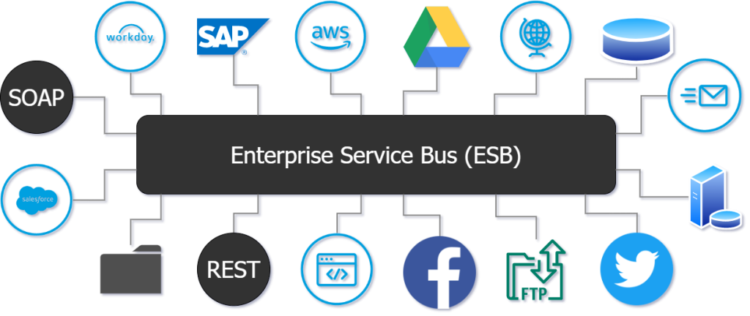
Before the emergence of service-oriented architecture (SOA), the term middleware would often be equated with an application server. However, today with the degree of progress on service-oriented architecture the term middleware will often be equated with Enterprise Service Bus (ESB). This is because if the application server is the foundation for middleware then ESB represents the largest and most important part of middleware in Service Oriented Architecture. Enterprise Service Bus (ESB) is a term used to describe a wide variety of products whose primary goal is to extend the simple messaging capabilities of an application server to allow the inclusion of enterprise functionality needed to support SOA. It has also been observed that a major difference between ESB and middleware is the fact that ESB is Service-Oriented whereas middleware has functions that are applicable outside the realm of services in a distributed system. The ESB can accomplish business communication by Continue reading

Six Dimensions of Emotional Style

According to neuroscientist Richard J. Davidson, each person has a unique emotional profile. As he puts it, “Just as each person has a unique fingerprint and a unique face, each of us has a unique emotional profile, one that is so much a part of who we are and those who know us well can often predict how we will respond to an emotional challenge.” Based on his research, Davidson identified six dimensions of Emotional Style in his classic work The Emotional Life of Your Brain written with Sharon Begley. According to him, Each of the six dimensions has a specific, identifiable neural signature—a good indication that they are real and not merely a theoretical construct. The six dimensions of Emotional Style are as follows : Resilience Style : People at one end of this dimension recover quickly from adversity whereas people at the other end of this dimension recover Continue reading

Case Study: Mergers and Acquisitions in the Automotive Industry

Different companies, similarly to people, have their own unique culture that is founded on ethnic, regional, temporal and industry-relevant factors. Therefore, when two or more businesses work together or decide to merge, these specific attributes may clash, leading to conflicts and worsened performance outcomes. The process of acquisition has to be planned in detail from the first contact between the companies to their full integration. In most successful cases, firms prepare thoroughly to enter the new relationship by mapping out the process of the merger and trying to predict the potential issues. However, the importance of the steps following the official merger may be overlooked by managers who fail to account for the fundamental cultural and structural differences between the businesses. In foreign mergers, this lack of attention to the whole strategy may be detrimental to the outcome of the project. This problem is especially evident for cultures that have Continue reading

Classification of Security Threats in Information Systems

As use of internet and related telecommunications technologies and systems has become pervasive, use of these networks now creates a new vulnerability for organizations or companies. These networks can be infiltrated or subverted a number of ways. As a result, organizations or companies will faced threats that affect and vulnerable to information system security. Threats to information system can come from a variety of places inside and external to an organizations or companies. In order to secure system and information, each company or organization should analyze the types of threats that will be faced and how the threats affect information system security. Examples of threats such as unauthorized access (hacker and cracker), computer viruses, theft, sabotage, vandalism and accidents. Unauthorized Access (Hacker and Cracker): One of the most common security risks in relation to computerized information systems is the danger of unauthorized access to confidential data. The main concern comes Continue reading