Ethics in Financial Reporting

Integrity is of utmost importance for a successful career in business and finance in the long run. Some believe that the world of finance lacks ethical considerations. Whereas the truth is that such issues are prevalent in all areas of business. The business environment in much of the world is reeling from the revelation of several financial scandals in the past few years. The optimism of the turn of the century has been replaced by scepticism and distrust. It will be discussed as to how we landed ourselves in this situation, what is being done to correct it, and what the future holds for us. Though Enron has been used as the poster-child for this purpose, breakdowns in accounting and corporate governance in Enron as well as in other companies will be discussed. Some companies that have encountered financial reporting problems will be discussed along with the role of auditors Continue reading
Mutual Fund Prospectus

A mutual fund prospectus is an offer document issued at the time of new issue of mutual funds, as an invitation to the public to subscribe to the units of a particular scheme. It contains the key information about the terms, conditions and the features of the mutual fund schemes and the application form. All mutual funds are required to give information about their schemes as per the format of the offer document prescribed by SEBI. Everyone agrees that the prospectus is the single best source of information about a mutual fund, yet as many of mutual fund investors do not use this critical document when investing their savings and retirement assets. The reason being the prospectus contains more information and is full of detailed information and uses complex terminology. As the minimum, an understanding of the following important aspects is necessary: Highlights of the Scheme: The main features of Continue reading

Eurocurrency Market

Prior to 1980 Eurocurrency markets are the only international financial market of any significance. They are offshore markets where financial institutions conduct transactions which are denominated in currencies of countries other than the country in which the institutions currencies of countries other than the country in which the institutions are located. The Eurocurrency market is outside the legal preview of the country in whose currency the finance are raised in the market. Eurocurrencies are bank deposits denominated in currencies other than the currency of the country in which the bank is located. The bank deposits and loans are denominated in Eurocurrencies, particularly dollars. Eurodollars are dollar denominated time deposits held by financial intuitions located outside the US., including such deposits by branches of U.S.,including such deposits held by branches of U.S.,banks. Thus a dollar with a bank in London or Paris is a Eurodollar deposit. Similarly, a Deutsche mark deposit Continue reading

Effective Leadership – Importance and Characteristics

Effective leadership includes achieving the organization’s goal and setting its tone and culture, planning and implementing strategies, acquiring resources, and recognizing and resolving conflicts. Leaders build employees’ strengths, talents and nature dedicated teams for a mutual benefit. Companies and other institutions all around the world have learned that teaching art to others can help to raise living standards. Effective leadership’s benefits to the success of an organization. It is obvious that the company’s leaders are supervisors as well, and they serve an important role in the daily operations and management of a business. To be a good leader, one must develop the leadership skills necessary to successfully deal with opposition as well as adopt the appropriate supervisory style, to understand employees’ abilities and challenges. Importance of Effective Leadership Effective leadership is critical to a company’s success because it offers direction and purpose while also supporting individuals in understanding the company’s Continue reading

The Diamond-Water Paradox in Economics

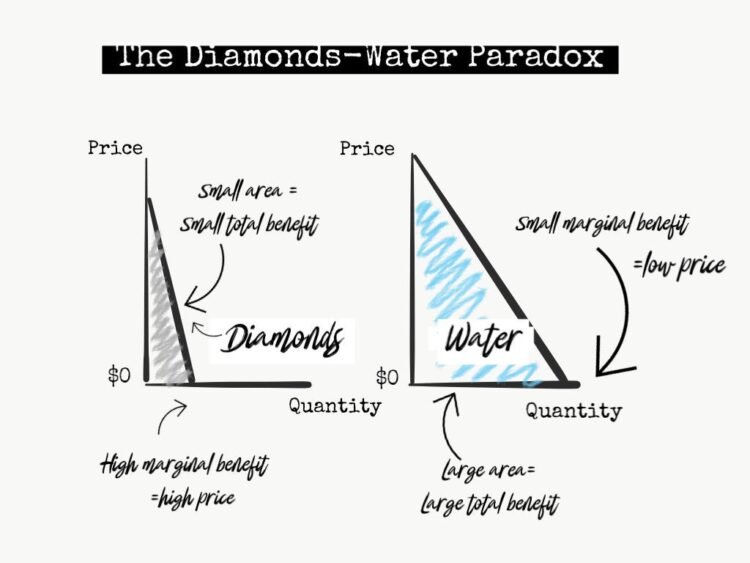
The concept of the value of goods was one of the most actively discussed topics by economists in the 18-19th century. In “A Study of the Nature and Causes of the Wealth of Nations,” published in 1776, Adam Smith voiced the question that would later become known as the diamond-water paradox. It sounded like this: “There is nothing more useful than water: but you can hardly buy anything with it… Diamond, on the contrary, has almost no use-value; but a very large number of other goods can often be obtained in exchange for it”. The classical economists Adam Smith and Karl Marx considered a product’s value concerning how it satisfies a human need. The price was associated with the effort and labor expended to meet a specific demand. Besides, classical economists used the concepts of use-value and exchange-value, which determine the nature and exchange value of products. Later, in the Continue reading

Econometric Forecasting Models

Econometric model building holds considerable promise as a method of forecasting demand. The best  starting point towards an understanding of the basis of econometric forecasting is regression analysis. But  the difficulty with regression analysis is that it is used to forecast a single dependent variable based on the  value and the relations between one or more independent variables and each of these independent variables is  assumed to be exogenous or outside the influence of the dependent variable. This may be true in many  situations. But unfortunately, in most broad economic situations an assumption that each of the variable,  is independent is  unrealistic. For example, let us assume that demand is a function of Gross National Product (GNP), price and  advertising. In  regression  terms we would assume that all three independent variables are exogenous to  the system and hence are not influenced by the level of demand itself or by one Continue reading